


Next: Observational results with single Up: Data reduction method Previous: Application to observational data Contents
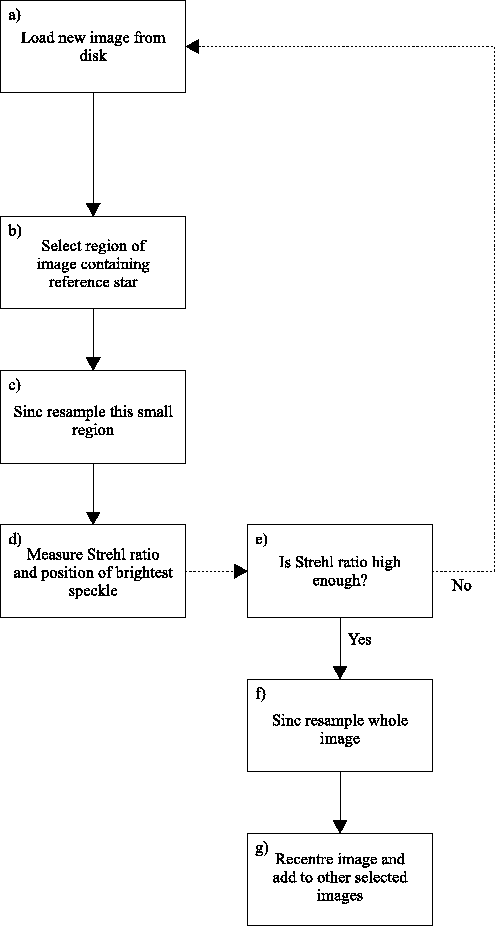 |
The sinc-resampling process described in panel c) of Figure 3.13 is one of the most computationally intensive parts of the data reduction as it involves two Fast Fourier Transforms (FFTs). By limiting the area of the image which is resampled to a small region around the reference star, the speed of the data reduction process is dramatically improved, allowing near real-time data-reduction while observing using a year 2000 vintage PC. The time-saving became even more significant in later runs using larger image dimensions.
After the position of the brightest speckle and Strehl ratio for each
short exposure had been calculated in panel d) of
Figure 3.13, the short exposures with the highest Strehl
ratios were selected for further processing. The full frame image for
each of these short exposures was sinc-resampled, and then re-centred
and co-added based on the location of the brightest pixel in the
reference star image as calculated in panel d). The process of sinc
resampling the full short exposure image was computationally
intensive, but this was only applied to the selected exposures
(typically  --
-- % of the total number of exposures).
Bob Tubbs 2003-11-14