


Next: Exposure selection Up: Data reduction method Previous: Data reduction method Contents
 used was
 calculated from the peak pixel
value in simulations of diffraction-limited PSFs pixellated in the
same way as the CCD observations. A summary of the results of this
analysis including a histogram of the Strehl ratios for the run on
calculated from the peak pixel
value in simulations of diffraction-limited PSFs pixellated in the
same way as the CCD observations. A summary of the results of this
analysis including a histogram of the Strehl ratios for the run on
 Aquilae was included in Baldwin et al. (2001).
The Strehl ratios calculated in this way provide a direct comparison
between the peak flux in the sinc-resampled short exposures with the
peak flux which would be expected in a diffraction-limited exposure
taken with the same camera. The sinc-resampling process produces a
small change in the peak pixel flux in the short exposure images
(typically  %) which leads to the slightly unsatisfactory
situation that simulated short exposures under diffraction-limited
atmospheric conditions processed in the same way give Strehl ratios
greater than unity (the sinc-resampled images have a higher peak flux
than the non-resampled images). This was resolved by recalculating the
constant based upon the peak flux in diffraction-limited PSFs
which had been sinc-resampled in the same way as the observational
data. The value of is reduced from to
%) which leads to the slightly unsatisfactory
situation that simulated short exposures under diffraction-limited
atmospheric conditions processed in the same way give Strehl ratios
greater than unity (the sinc-resampled images have a higher peak flux
than the non-resampled images). This was resolved by recalculating the
constant based upon the peak flux in diffraction-limited PSFs
which had been sinc-resampled in the same way as the observational
data. The value of is reduced from to
 in this case, causing a proportionate
decrease in the estimated Strehl ratios. The Strehl ratios presented
in this thesis were all calculated using the reduced value of ,
giving values which are slightly smaller than those quoted in
Baldwin et al. (2001).
in this case, causing a proportionate
decrease in the estimated Strehl ratios. The Strehl ratios presented
in this thesis were all calculated using the reduced value of ,
giving values which are slightly smaller than those quoted in
Baldwin et al. (2001).
The Strehl ratios calculated for the individual short exposures of
Aquilae were binned into a histogram, and this is plotted
alongside similar histograms calculated for a number of numerical
simulations in Figure 3.10. It was
possible to select atmospheric seeing conditions for each model which
led to good agreement between the model Strehl histograms and those
for the run on Aquilae. The four curves in the figure show:
 (those measured by Sørensen (2002)) and an atmosphere
having
(those measured by Sørensen (2002)) and an atmosphere
having  five times smaller than the telescope diameter;
 (with large scale structure removed) with an atmosphere having
seven times smaller than the telescope diameter;
(with large scale structure removed) with an atmosphere having
seven times smaller than the telescope diameter;
 , a diffraction-limited telescope
with an atmosphere having eight times smaller than the
telescope diameter; and
Aquilae.
, a diffraction-limited telescope
with an atmosphere having eight times smaller than the
telescope diameter; and
Aquilae.
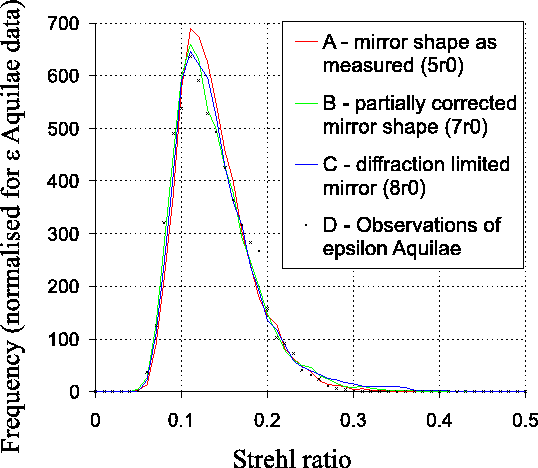 |
The mirror perturbations on the NOT primary mirror are likely to have
similar magnitude to those described by model , implying that the
most likely value for the atmospheric coherence length is
 or about
 .
.
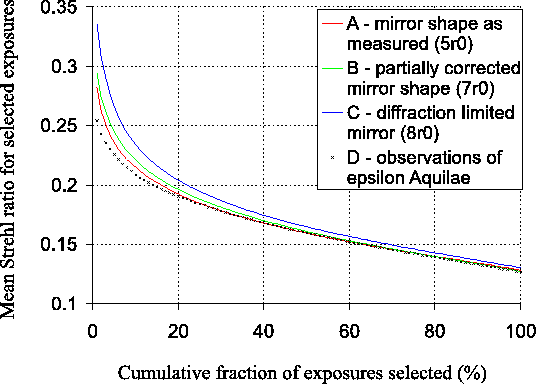
Figure 3.11 shows cumulative plots of the
Strehl ratio datasets used in
Figure 3.10. The exposures in each dataset
were first sorted by descending Strehl ratio. Plotted in the figure
for each dataset is the mean of the highest  of Strehl ratios,
the mean of the highest
of Strehl ratios,
the mean of the highest  of Strehl ratios, and so on up to the
mean of all the Strehl ratios in the dataset. These mean Strehl ratios
give an indication of the image quality which would be obtained if a
given fraction of exposures was selected for use in the Lucky Exposures method.
of Strehl ratios, and so on up to the
mean of all the Strehl ratios in the dataset. These mean Strehl ratios
give an indication of the image quality which would be obtained if a
given fraction of exposures was selected for use in the Lucky Exposures method.
 |
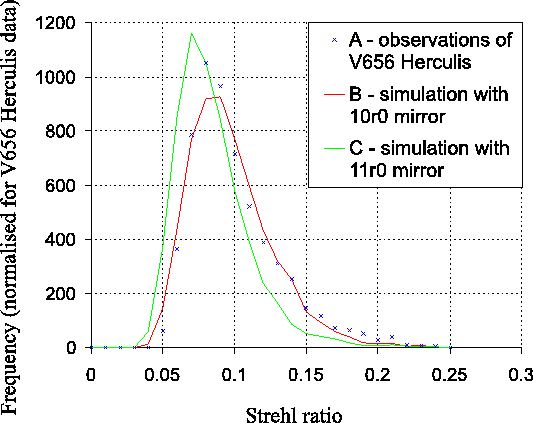
Strehl ratios were calculated in the same way for data taken on the
star V656 Herculis, and Curve A in
Figure 3.12 shows a histogram of the Strehl ratios
obtained. Also shown in the figure are Strehl ratio histograms for
simulations with a diffraction-limited telescope and atmospheric
seeing conditions corresponding to
 (labelled B)
and
(labelled B)
and
 (labelled C). Again there is close
correspondence between the simulated curves and the observational
results. The lower Strehl ratios as compared to the run on
Aquilae may result from slightly poorer seeing conditions, as
highlighted by the long exposure FWHM in Table 3.2.
(labelled C). Again there is close
correspondence between the simulated curves and the observational
results. The lower Strehl ratios as compared to the run on
Aquilae may result from slightly poorer seeing conditions, as
highlighted by the long exposure FWHM in Table 3.2.
 |
Bob Tubbs 2003-11-14


