Next: Application to observational data Up: Observations of bright sources Previous: Observations Contents
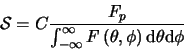
 in the image measured per steradian on the sky
(calculated from the flux in the brightest pixel). This was divided by
the total flux from the star in that exposure (integrated over the
whole image:
in the image measured per steradian on the sky
(calculated from the flux in the brightest pixel). This was divided by
the total flux from the star in that exposure (integrated over the
whole image:
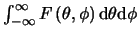 ). This gave an estimate
  of the Strehl
ratio:
of the Strehl
ratio:
The constant of proportionality  represents a measure of the area
of the PSF in steradians on the sky. In order to calculate the value
of required to normalise the Strehl ratios for the case of
diffraction-limited PSFs, it was necessary to generate a number of
simulated PSFs.
represents a measure of the area
of the PSF in steradians on the sky. In order to calculate the value
of required to normalise the Strehl ratios for the case of
diffraction-limited PSFs, it was necessary to generate a number of
simulated PSFs.
Simulated diffraction-limited PSFs were generated for the observing
wavelength of 
 with flat incoming wavefronts at various tilt
angles, using the aperture geometry described by
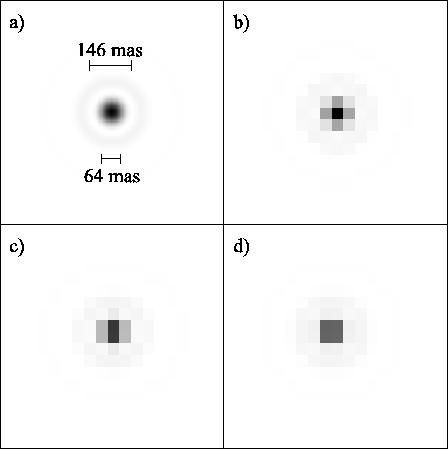
Equation 3.1. An example is shown in
Figure 3.8a. These were then binned into
with flat incoming wavefronts at various tilt
angles, using the aperture geometry described by
Equation 3.1. An example is shown in
Figure 3.8a. These were then binned into

 pixels to match the camera resolution. The
pixellated shape of the PSF was found to depend slightly on the tilt
of the incoming wavefronts (i.e. the position of the PSF in relation
to the pixel grid) as shown for three example PSFs in
Figures 3.8b--d. This led to a variation of
pixels to match the camera resolution. The
pixellated shape of the PSF was found to depend slightly on the tilt
of the incoming wavefronts (i.e. the position of the PSF in relation
to the pixel grid) as shown for three example PSFs in
Figures 3.8b--d. This led to a variation of  in the flux in the brightest pixel. Our estimate for the peak
flux density was taken as the flux in the brightest pixel divided by
the area of the pixel (
in the flux in the brightest pixel. Our estimate for the peak
flux density was taken as the flux in the brightest pixel divided by
the area of the pixel (
 for
for  pixels). By setting the Strehl ratio of these
diffraction-limited images to unity, values of were calculated
from Equation 3.2. The mean value of for
a grid of
pixels). By setting the Strehl ratio of these
diffraction-limited images to unity, values of were calculated
from Equation 3.2. The mean value of for
a grid of  different wavefront tilts was calculated as
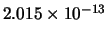
 (
( ).
).
 |
In order to investigate the accuracy of Strehl ratio measurements on
realistic PSFs, numerical simulations of observations were
undertaken using Kolmogorov atmospheres where the incident flux in the
image plane was integrated over individual pixels
in a square array, again resembling the optical layout for the camera
and CCD detector at the NOT. Strehl ratios for the individual short
exposures were calculated from the flux in the brightest pixel as
described above. The flux in the brightest pixel was found to vary at
the  % level depending on sub-pixel variations in the
position of the brightest speckle relative to the grid of pixels, in a
similar manner to the case of the diffraction-limited PSF shown in
Figures 3.8b--d. This implied a position dependent
error in the measured Strehl ratio at the
% level depending on sub-pixel variations in the
position of the brightest speckle relative to the grid of pixels, in a
similar manner to the case of the diffraction-limited PSF shown in
Figures 3.8b--d. This implied a position dependent
error in the measured Strehl ratio at the  % level (similar to the
case for a diffraction-limited PSF).
% level (similar to the
case for a diffraction-limited PSF).
So as to reduce the dependence of the measured Strehl ratio on the
position of the stellar image on the CCD pixel array, the simulated
short exposure images of the star were sinc-resampled to give four
times finer pixel sampling in each coordinate. This was performed in
the Fourier domain - the dimensions of the discrete Fourier domain
were increased by padding it with zeros, and the power at Nyquist
Fourier components was distributed equally at both positive and
negative frequencies. The sinc-resampling process preserves the
Fourier components with spatial frequencies below the Nyquist cutoff,
and does not introduce any power at spatial frequencies above this
cutoff. The Nyquist cutoff for the pixel sampling of the CCD in the
horizontal and vertical directions of 

 is only
slightly lower than highest spatial frequency components in the PSF
of around
is only
slightly lower than highest spatial frequency components in the PSF
of around
 (in other words
only a small range of spatial frequencies are not adequately sampled
by the CCD). Spatial frequency components of the PSF above the
Nyquist cutoff for the CCD pixel sampling are expected to contain
little power, making the sinc-resampled short exposures a reasonably
good approximation to the original PSF before the pixellation process
(although spatial frequencies just below the Nyquist cutoff of the CCD
array will be suppressed due to the finite pixel size). The four-fold
sinc-resampling process successfully reduced the variation in Strehl
ratio with image position to
(in other words
only a small range of spatial frequencies are not adequately sampled
by the CCD). Spatial frequency components of the PSF above the
Nyquist cutoff for the CCD pixel sampling are expected to contain
little power, making the sinc-resampled short exposures a reasonably
good approximation to the original PSF before the pixellation process
(although spatial frequencies just below the Nyquist cutoff of the CCD
array will be suppressed due to the finite pixel size). The four-fold
sinc-resampling process successfully reduced the variation in Strehl
ratio with image position to  or less. Further resampling with
even finer pixel spacing had little effect on the measured Strehl
ratios.
or less. Further resampling with
even finer pixel spacing had little effect on the measured Strehl
ratios.
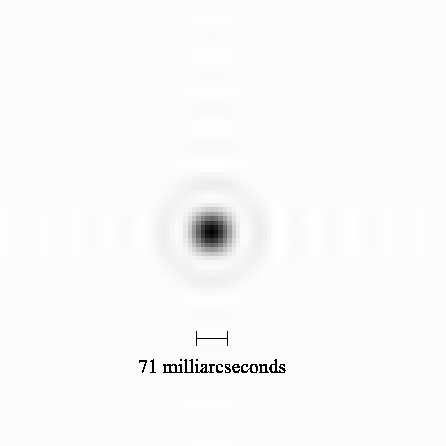
The ability of the sinc-resampling process to recreate the original
PSF is demonstrated in Figure 3.9. In this Figure,
diffraction-limited PSFs with a range of different position offsets
were pixellated in the same way as was shown in
Figures 3.8b--d. The pixellated images were then
sinc-resampled with four times as many pixels in both dimensions, and
the resulting images were shifted to a common centre and co-added to
form Figure 3.9. The Airy pattern is clearly
reproduced, and the FWHM of the image core is only slightly larger
than that for the true diffraction-limited PSF shown in
Figure 3.8a. The sinusoidal ripples extending in
both the horizontal and vertical directions from the core of
Figure 3.9 are a result of aliasing (Gibb's
phenomenon), as the Nyquist cutoff for the CCD pixel sampling in the
horizontal and vertical directions is slightly less than the highest
spatial frequency
 (the Nyquist cutoff frequency is
sufficiently high along the image diagonal that aliasing does not
occur).
(the Nyquist cutoff frequency is
sufficiently high along the image diagonal that aliasing does not
occur).
 |