


Next: Weighting exposures Up: Results with binary stars Previous: Strehl ratios obtained for zeta Bootis Contents
 Boötis, and have displayed them in
Figure 3.28. These Fourier autocorrelations preserve the
Fourier amplitude information, although all phase information is
lost. The Fourier autocorrelation provides a more intuitive
representation of the high resolution performance than the modulation
transfer function, as the structures in the image autocorrelation can
be related directly to structure in the images.
Boötis, and have displayed them in
Figure 3.28. These Fourier autocorrelations preserve the
Fourier amplitude information, although all phase information is
lost. The Fourier autocorrelation provides a more intuitive
representation of the high resolution performance than the modulation
transfer function, as the structures in the image autocorrelation can
be related directly to structure in the images.
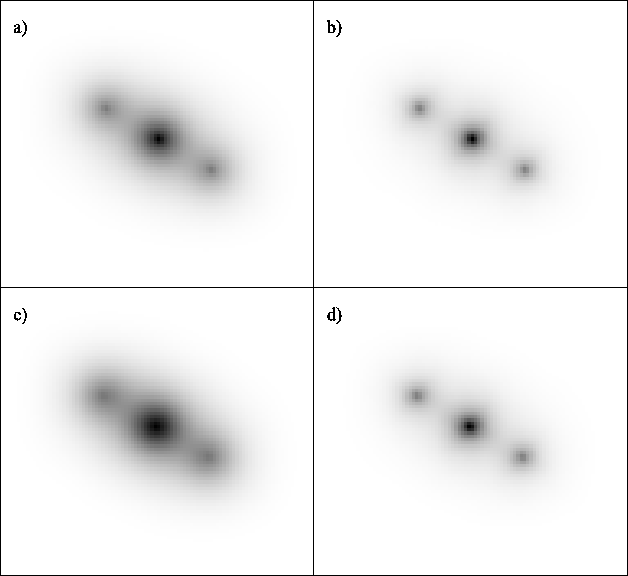 |
Figure 3.28a shows the summation of the autocorrelations
for all the short exposures used in the analysis. This image
essentially represents the method of Labeyrie (1970) as applied to
our data on Boötis. Figure 3.28b shows the
summation of the autocorrelations for only those exposures having the
highest  % of Strehl ratios. This autocorrelation has a much more
compact core and a fainter halo, indicating that the best % of
exposures preserve significantly more high spatial frequency
information.
% of Strehl ratios. This autocorrelation has a much more
compact core and a fainter halo, indicating that the best % of
exposures preserve significantly more high spatial frequency
information.
It is now of interest to compare the autocorrelations of Figure 3.28a and 3.28b (generated directly from the raw data) with the autocorrelations obtained after the short exposures have been processed using either the conventional shift-and-add approach or using the Lucky Exposures method. Figure 3.28c shows the autocorrelation generated from the conventional shift-and-add image based on the same exposures as were used in Figure 3.28a. The shift-and-add process has produced a substantial reduction in the sharpness of the final autocorrelation, which indicates that the shift-and-add image itself is somewhat degraded in resolution. On the other hand, the autocorrelation of the shift-and-add image generated using the selected exposures (Figure 3.28d) is almost as sharp as that generated directly from the original exposures (Figure 3.28b). It is clear that with the Lucky Exposures method, one benefits not only from the higher resolution of the selected exposures themselves, but also from a substantial improvement in the performance of the shift-and-add process when it is applied to these high Strehl ratio exposures.


