


Next: Dynamic range Up: Results with binary stars Previous: Temporal and spatial cross Contents
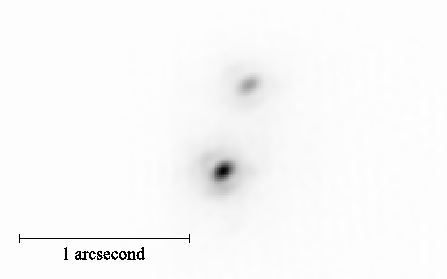
 Delphini
 of images with the best Strehl ratios from a dataset of
  short-exposure CCD images of the binary Delphini. In this case
the zenith angle of the observation was
short-exposure CCD images of the binary Delphini. In this case
the zenith angle of the observation was  and the images
are blurred by
and the images
are blurred by 
 due to atmospheric dispersion over the

 bandpass of the filter, reducing the Strehl ratio of the
final image to
bandpass of the filter, reducing the Strehl ratio of the
final image to  . This dispersion results from the variation in
the refractive index of air with wavelength, which causes a
change in the atmospheric refraction angle as a function of
wavelength. It can be corrected using glass prisms with an appropriate
wedge angle.
. This dispersion results from the variation in
the refractive index of air with wavelength, which causes a
change in the atmospheric refraction angle as a function of
wavelength. It can be corrected using glass prisms with an appropriate
wedge angle.
 |
The magnitude difference between the components is
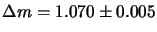 . This value is in good agreement with those
of Barnaby et al. (2000) of
. This value is in good agreement with those
of Barnaby et al. (2000) of 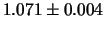 at
at  and
and
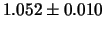 at
at  made using a
 telescope.