


Next: Atmospheric dispersion and beta Delphini Up: Results with binary stars Previous: Anisoplanatism Contents
 --
--
 later), as shown in
Figure 3.34a.
later), as shown in
Figure 3.34a.
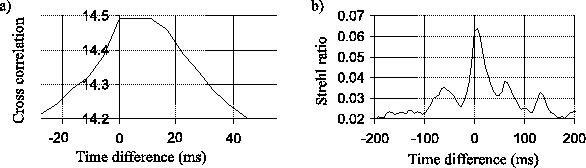 |
Figure 3.34b shows the effect of finding the
highest  of reference star Strehl ratios, but actually selecting
exposures an integer number of frames before or after the frame with
the high reference star Strehl ratio. The image re-centring was also
based on measurements of the reference star in the exposure with the
high reference star Strehl ratio, and not the exposure actually
used. The Strehl ratio obtained on the binary companion in the final
image is plotted against the delay between the Strehl ratio and
reference star position measurements and the application of these
measurements to the data. The peak Strehl ratio for the companion star
is obtained if the delay is . The curve has the same general
shape as that for self referencing with
of reference star Strehl ratios, but actually selecting
exposures an integer number of frames before or after the frame with
the high reference star Strehl ratio. The image re-centring was also
based on measurements of the reference star in the exposure with the
high reference star Strehl ratio, and not the exposure actually
used. The Strehl ratio obtained on the binary companion in the final
image is plotted against the delay between the Strehl ratio and
reference star position measurements and the application of these
measurements to the data. The peak Strehl ratio for the companion star
is obtained if the delay is . The curve has the same general
shape as that for self referencing with  Aquilae, shown in
Figure 3.18, except for the time delay.
Aquilae, shown in
Figure 3.18, except for the time delay.
The observed delay in the response of the binary companion image to
fluctuations in the reference star image suggests the presence of an
intermediate or high altitude layer of seeing moving with a velocity
which has a component along the axis of the binary separation in the
plane of the sky. Phase perturbations experienced by the reference
star are thus blown into the beam of light from the binary companion
between and later, producing the observed
cross-correlation.

