


Next: Temporal and spatial cross Up: Results with binary stars Previous: Weighting exposures Contents

 binary
 Leonis provide measurements of the atmospheric perturbations
along two paths through atmosphere. The difference in the speckle
pattern observed for the two binary components gives a measure of the
isoplanatism in the atmosphere. For the purposes of this analysis I
will consider the isoplanatic angle
Leonis provide measurements of the atmospheric perturbations
along two paths through atmosphere. The difference in the speckle
pattern observed for the two binary components gives a measure of the
isoplanatism in the atmosphere. For the purposes of this analysis I
will consider the isoplanatic angle  to be the separation
from a reference star which causes a reduction by a factor of
to be the separation
from a reference star which causes a reduction by a factor of
 in the Strehl ratio of an unresolved target.
The isoplanatic angle for the Lucky Exposures technique should be
very similar to the angle at which the speckle patterns for the two
stars have decorrelated by a factor of . The argument for
this is based on the direct parallels between the decorrelation of the
speckle pattern as a function of angle and the decorrelation of the
speckle pattern as a function of time discussed in
Chapter 2.4. Measurements in
Chapter 3.4.3 indicated that the decrease in the
Strehl ratio with time followed the decorrelation occurring at another
(arbitrary) point in the speckle pattern with time, and the same
relationship would be expected as a function of angle between the
reference star and an off-axis target. The isoplanatic angle
is thus expected to be analogous to the timescale
 for changes in the speckle pattern.
Measurements of would ideally be obtained from
simultaneous observations of a target very close to the reference
star, and another target at a separation which produced a Strehl ratio
lower by a factor of . As appropriate data is not
available here, a model of the effect of atmosphere is required in
order to extrapolate the results, leading to some uncertainty in the
accuracy of the result.
In order to obtain the best possible temporal sampling, the second run
on Leonis with the higher frame rate of 
 was used
in this analysis (as described in Table 3.3). The
left-hand (fainter) star was used as a reference for selecting the
best
was used
in this analysis (as described in Table 3.3). The
left-hand (fainter) star was used as a reference for selecting the
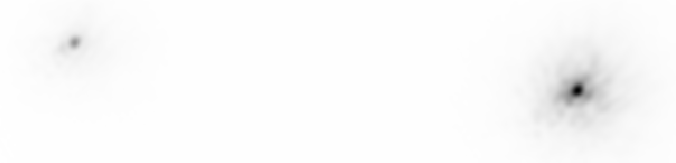
best  of exposures, and the resulting image is shown in
Figure 3.31. The reference star Strehl ratio is
of exposures, and the resulting image is shown in
Figure 3.31. The reference star Strehl ratio is  ,
unusually low for observations in this period of NOT technical time.
This suggests that the seeing may have been poorer for this run.
,
unusually low for observations in this period of NOT technical time.
This suggests that the seeing may have been poorer for this run.
 |
We cannot tell exactly what Strehl ratio could be obtained in the
vicinity of the reference star. However, the high signal-to-noise for
these observations, and the high level of correlation between the
stars in the close binary  Boötis suggest that the Strehl
ratio for the reference star gives us a reasonable approximation for
the Strehl ratio which would be obtained on a nearby target. The
right-hand star in Figure 3.31 has a Strehl ratio only
Boötis suggest that the Strehl
ratio for the reference star gives us a reasonable approximation for
the Strehl ratio which would be obtained on a nearby target. The
right-hand star in Figure 3.31 has a Strehl ratio only
 as high as that for the reference star. The lower Strehl ratio
implies that the images of the two stars are partially decorrelated in
the short exposures. This decorrelation probably results from
anisoplanatism related to the separation of the binary. In order to
calculate the separation from the reference star which would give a
Strehl ratio of it would be necessary to know the detailed
structure of the atmosphere at the time of the observations. Fitting
models of the form of Equation 2.20 or similar
to those of Roddier et al. (1982b) give values between
as high as that for the reference star. The lower Strehl ratio
implies that the images of the two stars are partially decorrelated in
the short exposures. This decorrelation probably results from
anisoplanatism related to the separation of the binary. In order to
calculate the separation from the reference star which would give a
Strehl ratio of it would be necessary to know the detailed
structure of the atmosphere at the time of the observations. Fitting
models of the form of Equation 2.20 or similar
to those of Roddier et al. (1982b) give values between  and
and
 . Much better constraints could be put on this if wider
binaries were observed - the observations in 2000 were somewhat
limited by the maximum pixel rates at which the camera could operate,
and hence the field of view which could be used for high frame-rate
imaging. It is possible that better seeing conditions present for the
runs on other targets might have also given a different (presumably
larger) isoplanatic angle.
. Much better constraints could be put on this if wider
binaries were observed - the observations in 2000 were somewhat
limited by the maximum pixel rates at which the camera could operate,
and hence the field of view which could be used for high frame-rate
imaging. It is possible that better seeing conditions present for the
runs on other targets might have also given a different (presumably
larger) isoplanatic angle.
Figure 3.32 shows a shift-and-add image utilising
all of the short exposures. The faint halo around the stars is more
obvious in this image, but it is also much smoother in appearance. The
smoothness is probably a result of the larger number of different
short exposures involved, each representing a different atmospheric
realisation. The Strehl ratio of the left hand star in this case is
 . The Strehl ratio for the right-hand star is
  , only a
factor of two higher than the Strehl ratio of the long exposure seeing
disk. The Strehl ratio of this star is
, only a
factor of two higher than the Strehl ratio of the long exposure seeing
disk. The Strehl ratio of this star is  % as high as that for the
left hand star, again suggesting significant anisoplanatism.
% as high as that for the
left hand star, again suggesting significant anisoplanatism.
 |
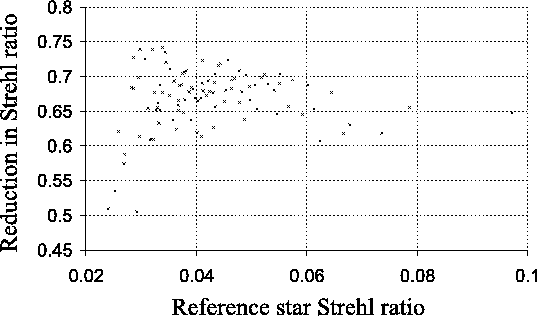
The reduction in the Strehl ratio brought about by anisoplanatism was
measured using different criteria for exposure selection. The
exposures of Leonis were binned into one hundred equal groups
each containing exposures with similar reference star Strehl ratios,
as had been performed for data on Boötis in
Figure 3.23. The exposures in each group were
shifted and co-added, resulting in a set of  images. The Strehl
ratios for the reference star and the binary companion were calculated
for each of these images. The high signal-to-noise ratio for these
observations mean that the ratio of the binary companion Strehl to the
reference star Strehl is a good measure of the reduction factor for
the off-axis Strehl ratio brought about by atmospheric anisoplanatism.
Figure 3.33 shows such measurements, plotted
against the reference star Strehl ratio. It is clear that the
fractional reduction in Strehl ratio brought about by atmospheric
anisoplanatism for this data is not strongly dependent on the
reference star Strehl ratio if the Strehl ratio is greater than
images. The Strehl
ratios for the reference star and the binary companion were calculated
for each of these images. The high signal-to-noise ratio for these
observations mean that the ratio of the binary companion Strehl to the
reference star Strehl is a good measure of the reduction factor for
the off-axis Strehl ratio brought about by atmospheric anisoplanatism.
Figure 3.33 shows such measurements, plotted
against the reference star Strehl ratio. It is clear that the
fractional reduction in Strehl ratio brought about by atmospheric
anisoplanatism for this data is not strongly dependent on the
reference star Strehl ratio if the Strehl ratio is greater than
 .
.
 |
It should be noted that the fractional reduction in Strehl ratio
brought about by atmospheric anisoplanatism does not provide a direct
measure of the size of the isoplanatic patch. The long exposure image
constructed from the same data has a Strehl ratio of  , and it
will be unlikely that the Strehl ratios for short exposures would fall
substantially below this value however small the isoplanatic
patch. For low reference star Strehl ratios there will be a lower
limit on the companion star Strehl ratio set by the finite size of the
seeing disk into which most of the light from the companion star will
fall (regardless of the anisoplanatism). This will tend to bias the
companion star Strehl ratios obtained for low reference star Strehl
ratios, and may explain why the Strehl ratios of the two stars are
more similar under these conditions.
, and it
will be unlikely that the Strehl ratios for short exposures would fall
substantially below this value however small the isoplanatic
patch. For low reference star Strehl ratios there will be a lower
limit on the companion star Strehl ratio set by the finite size of the
seeing disk into which most of the light from the companion star will
fall (regardless of the anisoplanatism). This will tend to bias the
companion star Strehl ratios obtained for low reference star Strehl
ratios, and may explain why the Strehl ratios of the two stars are
more similar under these conditions.
Given the lack of a model for the stratification of the atmosphere at the time of the observation, it is not possible to determine how the Strehl ratio should vary as a function of binary separation, and so we cannot say with any certainty that the isoplanatic patch is larger or smaller in the Lucky Exposures than it is in typical exposures.