


Next: Seeing conditions Up: Results with binary stars Previous: Atmospheric dispersion and beta Delphini Contents
 Herculis were also obtained on the
night of 2003 May 13. The brighter primary component saturated the
detector, but it was possible to perform exposure selection on the
faint companion (typically three magnitudes fainter, depending on the
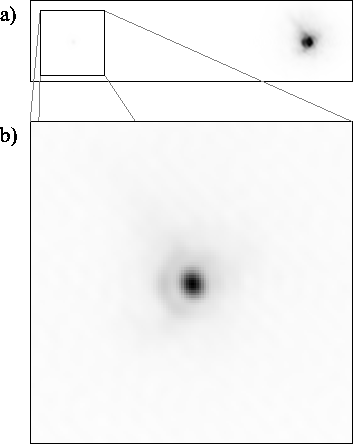
variable brightness of the primary component), as shown in
Figure 3.36. The absence of significant scattered light from
the bright companion emphasises the potential to perform high-dynamic
range imaging given suitable camera performance. There is no evidence
that the primary component is a
Herculis were also obtained on the
night of 2003 May 13. The brighter primary component saturated the
detector, but it was possible to perform exposure selection on the
faint companion (typically three magnitudes fainter, depending on the
variable brightness of the primary component), as shown in
Figure 3.36. The absence of significant scattered light from
the bright companion emphasises the potential to perform high-dynamic
range imaging given suitable camera performance. There is no evidence
that the primary component is a 
 binary as suggested by
McAlister et al. (1989), but this cannot be ruled out due to the detector
saturation.
binary as suggested by
McAlister et al. (1989), but this cannot be ruled out due to the detector
saturation.
 |

