


Next: Conclusions Up: Results with binary stars Previous: Dynamic range Contents
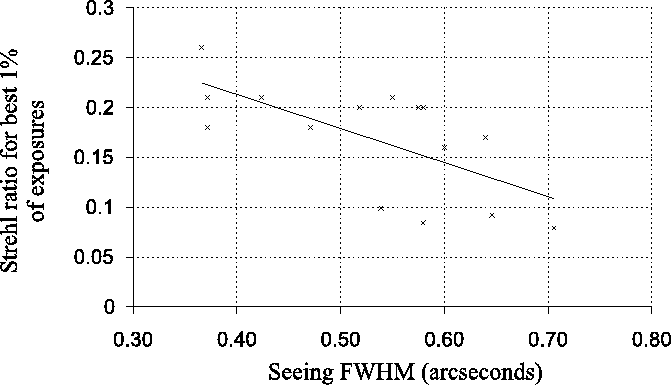
 of exposures were selected in each case, and the Strehl ratio
for the image obtained in this way is plotted against the FWHM of the
seeing disk in Figure 3.37. There is a clear relationship
between these two parameters, indicating (as expected) that the
highest image quality is obtained under conditions where the
conventional seeing disk is small. The scatter in the results may
be due to the strong dependence of seeing FWHM on the low-order
tip-tilt components in the wavefront perturbations, which have
insignificant effect on the Lucky Exposures image quality. The regression
coefficient for the fitted line is
of exposures were selected in each case, and the Strehl ratio
for the image obtained in this way is plotted against the FWHM of the
seeing disk in Figure 3.37. There is a clear relationship
between these two parameters, indicating (as expected) that the
highest image quality is obtained under conditions where the
conventional seeing disk is small. The scatter in the results may
be due to the strong dependence of seeing FWHM on the low-order
tip-tilt components in the wavefront perturbations, which have
insignificant effect on the Lucky Exposures image quality. The regression
coefficient for the fitted line is  .
.
 |
Bob Tubbs 2003-11-14