


Next: Limiting magnitude of reference Up: Results Previous: Results of exposure selection Contents

 ), and frame rates
greater than
), and frame rates
greater than 
 were used for the data presented here.
For each observation, one of the binary components was used as a
reference star, and the image FWHM and Strehl ratio of the other
component was measured in the final Lucky Exposures
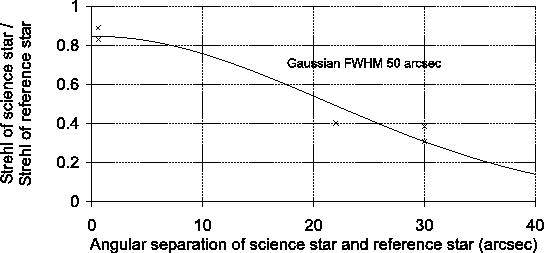
image. Figure 5.14 shows the fractional reduction in
Strehl ratio (i.e. the companion star Strehl ratio divided by the
reference star Strehl ratio) for the binary stars HD 203991, 8
Lacertae and 61 Cygnii with separations of  ,
,  and
and  respectively.
 |
As in Chapter 3.5.6 I will define the
isoplanatic angle  as that at which the Strehl ratio falls
to
as that at which the Strehl ratio falls
to  of the value obtained close to the reference star. A
model for the anisoplanatism is required in order to calculate the
size of the isoplanatic patch from measurements such as these. For
both the best fit Gaussian model (shown in Figure 5.14)
and for a fit of the form of Equation 2.20 a
value of is obtained.
of the value obtained close to the reference star. A
model for the anisoplanatism is required in order to calculate the
size of the isoplanatic patch from measurements such as these. For
both the best fit Gaussian model (shown in Figure 5.14)
and for a fit of the form of Equation 2.20 a
value of is obtained.
The separation for 61 Cygnii was close to the measured
, and it is of interest to look at the image quality
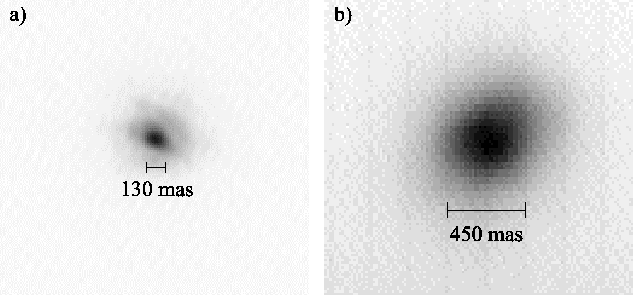
obtained on this star. The Lucky Exposures image on one component generated using
the other binary component to select and re-centre the best  of
exposures is displayed alongside the seeing-limited average image in
Figure 5.15. The FWHM of
of
exposures is displayed alongside the seeing-limited average image in
Figure 5.15. The FWHM of 
 obtained for the Lucky Exposures
image represents a substantial improvement over the FWHM of
obtained for the Lucky Exposures
image represents a substantial improvement over the FWHM of
 for the seeing-limited image. The halo around the core of
the Lucky Exposures image is very compact, and it is clear that this PSF would
provide good quality high resolution imaging. Any differential motion
between the images of the two stars must have been extremely small.
The FWHM of the companion star in the Lucky Exposures image increases to
for the seeing-limited image. The halo around the core of
the Lucky Exposures image is very compact, and it is clear that this PSF would
provide good quality high resolution imaging. Any differential motion
between the images of the two stars must have been extremely small.
The FWHM of the companion star in the Lucky Exposures image increases to
 when the best
  of exposures are selected using the
reference star. For a shift-and-add image using all of the exposures
the FWHM of the companion star is
of exposures are selected using the
reference star. For a shift-and-add image using all of the exposures
the FWHM of the companion star is  .
.
 |
An isoplanatic angle of is impressively large for
observations at I-band. Previous authors have predicted much smaller
values of isoplanatic angle, both for speckle imaging and
non-conjugate adaptive optics (typically  --
-- - see
e.g. Roddier et al. (1982a); Vernin & Muñoz-Tuñón (1994); Roddier et al. (1990); Marks et al. (1999)). Observations at
other wavelengths can be scaled to give a corresponding value for
I-band using the dependence of
- see
e.g. Roddier et al. (1982a); Vernin & Muñoz-Tuñón (1994); Roddier et al. (1990); Marks et al. (1999)). Observations at
other wavelengths can be scaled to give a corresponding value for
I-band using the dependence of  on wavelength given in
Equation 2.9.
on wavelength given in
Equation 2.9.
On several nights in June and July 2003 high frame-rate observations
of the globular clusters M13 and M15 were obtained covering fields
which were  across. It is hoped that these datasets will
provide a set of isoplanatic angle measurements which can be used to
determine whether the result obtained in 2001 is unusual or typical of
the summer seeing conditions at the NOT. Initial results from these
observations look very promising, but detailed analyses will not be
presented here.
across. It is hoped that these datasets will
provide a set of isoplanatic angle measurements which can be used to
determine whether the result obtained in 2001 is unusual or typical of
the summer seeing conditions at the NOT. Initial results from these
observations look very promising, but detailed analyses will not be
presented here.