Next: Assessment of image quality Up: Results Previous: Isoplanatic angle Contents
 of the
  exposures with this
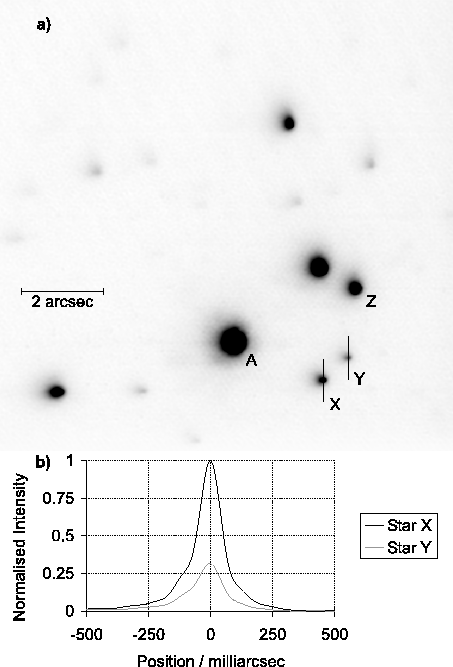
telescope pointing is shown in Figure 5.16a. The
exposures with this
telescope pointing is shown in Figure 5.16a. The
 star labelled Z in the image was used as the reference
for image selection and re-centring in this case. The frame rate used
for these observations was
star labelled Z in the image was used as the reference
for image selection and re-centring in this case. The frame rate used
for these observations was 
 , giving a total integration time
on the sky of
, giving a total integration time
on the sky of 
 . Star A from Cohen et al. (1997) is labelled
in the figure. This star was saturated in the best short exposures,
and has hence been omitted from further analyses. The stellar image
FWHM of
. Star A from Cohen et al. (1997) is labelled
in the figure. This star was saturated in the best short exposures,
and has hence been omitted from further analyses. The stellar image
FWHM of 
 are very competitive with other imaging
techniques. The image shows faint asymmetrical horizontal tails around
the fainter stars, which may be evidence of poor charge transfer
efficiency (vertical tails are also visible in the cross-sections of
Figure 5.16b). The electrical heating was not
connected at the time these runs were taken, so it is plausible that
the charge transfer efficiency might have been poorer here than during
other runs on the same night. Despite this effect, the stellar cores
throughout the image are extremely compact.
are very competitive with other imaging
techniques. The image shows faint asymmetrical horizontal tails around
the fainter stars, which may be evidence of poor charge transfer
efficiency (vertical tails are also visible in the cross-sections of
Figure 5.16b). The electrical heating was not
connected at the time these runs were taken, so it is plausible that
the charge transfer efficiency might have been poorer here than during
other runs on the same night. Despite this effect, the stellar cores
throughout the image are extremely compact.
 |
The analysis of this data was repeated using a range of different
stars in the field as the reference for exposure selection and
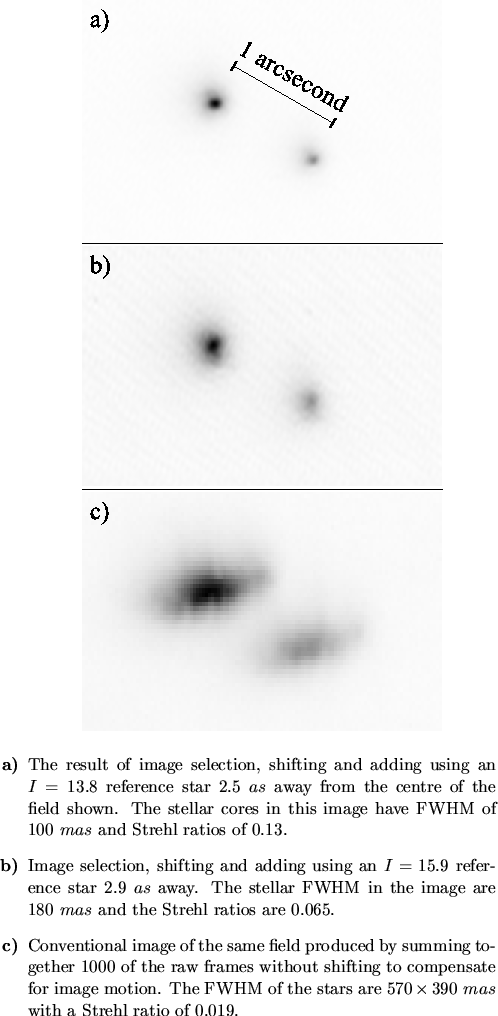
re-centring. The Lucky Exposures method was found to work very successfully with
relatively faint reference stars. First the  star labelled
X in Figure 5.16 was used as a reference for
selecting the best of exposures and re-centring them. A section
of the resulting image (the region around the star labelled Z
in Figure 5.16) is shown in
Figure 5.17a. Note that neither of the two
stars visible in this figure was used as the reference in this case
(star X was used) and yet the stellar cores are extremely
sharp. The Strehl ratio for the stars in this image was measured as
star labelled
X in Figure 5.16 was used as a reference for
selecting the best of exposures and re-centring them. A section
of the resulting image (the region around the star labelled Z
in Figure 5.16) is shown in
Figure 5.17a. Note that neither of the two
stars visible in this figure was used as the reference in this case
(star X was used) and yet the stellar cores are extremely
sharp. The Strehl ratio for the stars in this image was measured as
 . Figure 5.17b shows a similar image
generated using an
. Figure 5.17b shows a similar image
generated using an  reference star. The Strehl ratio of
 still represents a substantial improvement over the Strehl
ratio of
still represents a substantial improvement over the Strehl
ratio of  for the averaged (long exposure) image shown in
Figure 5.17c. The image FWHM of
for the averaged (long exposure) image shown in
Figure 5.17c. The image FWHM of  for Figure 5.17b would be extremely valuable
for many astrophysical programs, and represents an enormous
improvement over the
for Figure 5.17b would be extremely valuable
for many astrophysical programs, and represents an enormous
improvement over the  for the long exposure
image. The asymmetry in the long exposure image might be the result of
telescope tracking errors, as M13 was close to the zenith. The
position of the brightest speckle in the image of a reference star
shows jumps in the horizontal direction, as can be seen in
Figure 5.18.
for the long exposure
image. The asymmetry in the long exposure image might be the result of
telescope tracking errors, as M13 was close to the zenith. The
position of the brightest speckle in the image of a reference star
shows jumps in the horizontal direction, as can be seen in
Figure 5.18.
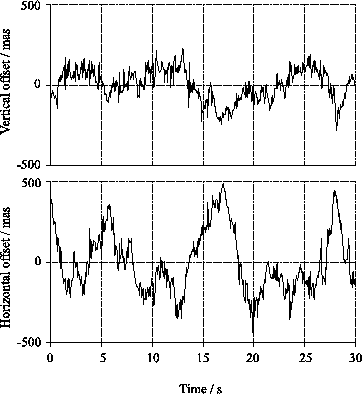 |
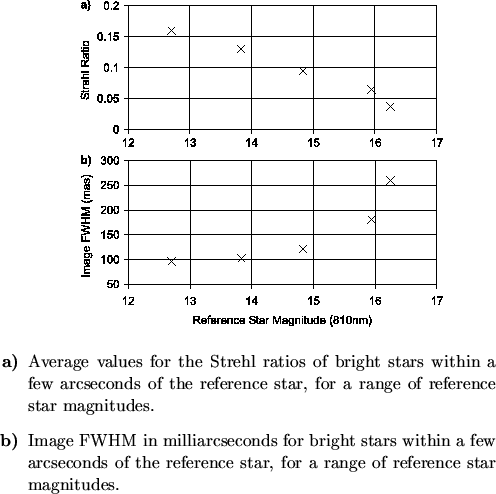
Figure 5.19 shows plots of the variation in the Strehl
ratio and FWHM of nearby stars when a range of different stars are
used as the reference for image selection and for the shifting and
adding process. of the exposures were selected in the analyses
used to generate these plots, and the Strehl ratios and FWHM were
calculated using nearby stars in order to minimise the effects of
anisoplanatism. Figure 5.19a shows the decline in Strehl
ratio with increasingly faint reference star magnitude. The Strehl
ratio of the Lucky Exposures image remains substantially higher than the
seeing-limited value of even for reference stars as faint as
 . Figure 5.19b shows the image FWHM obtained using
the same reference stars. An image FWHM of
. Figure 5.19b shows the image FWHM obtained using
the same reference stars. An image FWHM of  can be achieved
using reference stars as faint as
can be achieved
using reference stars as faint as  , and there is a substantial
improvement over the FWHM for the seeing-limited image of
even for reference stars.
, and there is a substantial
improvement over the FWHM for the seeing-limited image of
even for reference stars.
The faint limiting magnitude for the Lucky Exposures method stems partly from the
high signal-to-noise ratio for measurements of the brightest speckle
in those exposures having the highest Strehl ratios. This is
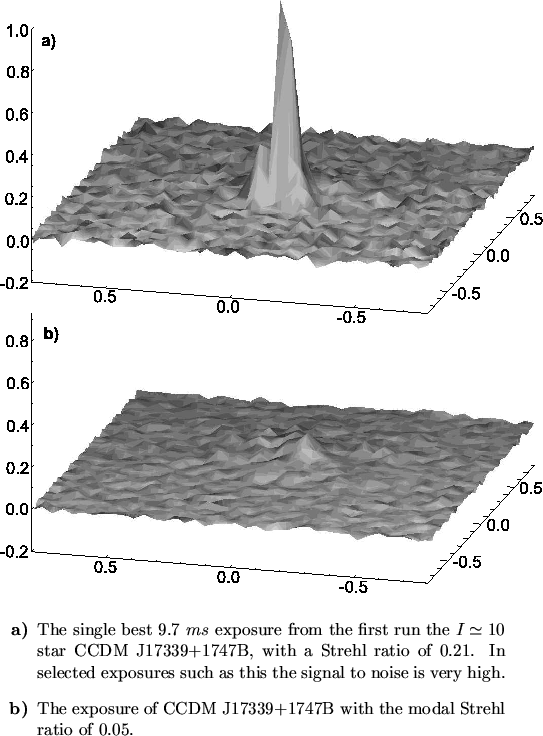
highlighted in Figure 5.20, which shows surface
plots of two frames taken from a run on the  star
CCDM J17339+1747B on 2001 July 26 (listed in
Table 5.2). Figure 5.20a shows an
exposure with a high Strehl ratio (
star
CCDM J17339+1747B on 2001 July 26 (listed in
Table 5.2). Figure 5.20a shows an
exposure with a high Strehl ratio ( ). The location and Strehl
ratio of the brightest speckle in this image can be measured with a
high signal-to-noise ratio. Good results would be obtained if
exposures such as this were re-centred based on the location of the
brightest speckle. In contrast, Figure 5.20b shows a
typical exposure with poorer Strehl ratio. The brightest speckle has a
peak flux which is barely above the noise level, and the errors in
determining the location of the brightest speckle will be
substantially higher in this case. If a large fraction of the
exposures are selected and re-centred, these errors would lead to
poorer image quality for other objects in the field around the
reference star. Conversely, if only those exposures with high Strehl
ratios are used, we would expect the re-centring errors to be
smaller. Combined with the higher intrinsic Strehl ratios in the
selected exposures, these should lead to much higher image resolution
for objects in the field.
). The location and Strehl
ratio of the brightest speckle in this image can be measured with a
high signal-to-noise ratio. Good results would be obtained if
exposures such as this were re-centred based on the location of the
brightest speckle. In contrast, Figure 5.20b shows a
typical exposure with poorer Strehl ratio. The brightest speckle has a
peak flux which is barely above the noise level, and the errors in
determining the location of the brightest speckle will be
substantially higher in this case. If a large fraction of the
exposures are selected and re-centred, these errors would lead to
poorer image quality for other objects in the field around the
reference star. Conversely, if only those exposures with high Strehl
ratios are used, we would expect the re-centring errors to be
smaller. Combined with the higher intrinsic Strehl ratios in the
selected exposures, these should lead to much higher image resolution
for objects in the field.
 |
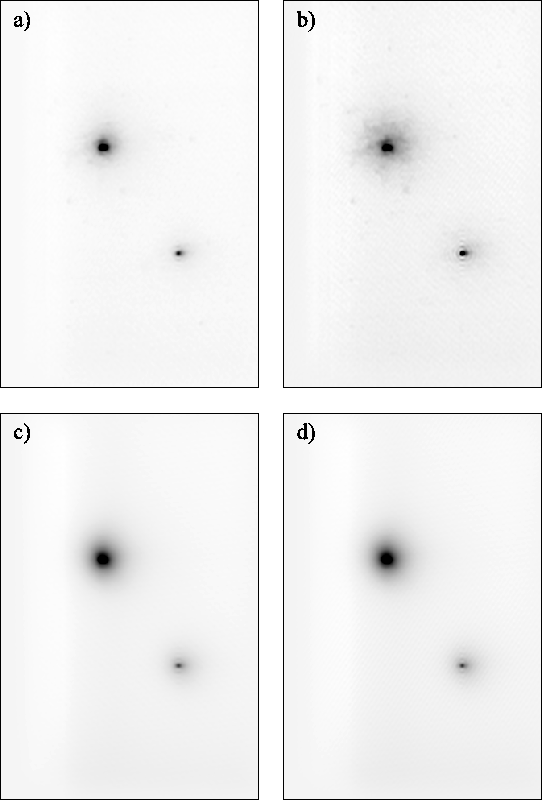
The Lucky Exposures image quality obtained from the run on CCDM J17339+1747AB is
summarised in Figure 5.21. The lower right
star was the one shown in Figure 5.20, and this star
was used as the reference for exposure selection and re-centring.
Figure 5.21a shows the image obtained by selecting
and re-centring the best of exposures based on the brightest
pixel in the filtered exposures in the usual
way. Figure 5.21b shows the result obtained if the
brightest pixel in the raw short exposures is used without Fourier
filtering using the function shown in Figure 5.6 for
calculations of the Strehl ratio and position of the brightest
speckle. The halo around the bright star is clearly less compact in
this image. Figures 5.21c and
5.21d show images generated in the same way but
using all of the exposures. The re-centring process was based on the
position of the brightest pixel in the raw exposures for the fainter
star at the lower right for Figures 5.21d. Despite
the relatively low signal-to-noise ratio apparent in
Figure 5.20, the re-centring process has reduced the
image FWHM to  from
from 
 achieved without
re-centring. Good image quality is obtained at this signal-to-noise
even without filtering out the noise.
achieved without
re-centring. Good image quality is obtained at this signal-to-noise
even without filtering out the noise.
 |
Using the flux calibration for an A0 V star in Cox (2000)
and the predicted throughput of the telescope, instrument, filter and
CCD quantum efficiency shown Figure 5.5 I calculated
the number of detected photons expected from a reference
star in a single 
 exposure. The total transmission under
curve B corresponds to an equivalent bandpass of
exposure. The total transmission under
curve B corresponds to an equivalent bandpass of

 with
with  transmission. Using a value of


 for the flux from an at
 wavelength this would imply a rate of
 detected photons per second. In a exposure we would thus
expect about
detected photons per second. In a exposure we would thus
expect about  photons. If the Strehl ratio in a good exposure is
 ,
,  of this flux will fall in one bright speckle
(corresponding to about
of this flux will fall in one bright speckle
(corresponding to about  photons). Taking the simplified model
for the signal-to-noise ratio with L3Vision CCDs described by
Equation 4.20, we expect a signal-to-noise ratio
of about
photons). Taking the simplified model
for the signal-to-noise ratio with L3Vision CCDs described by
Equation 4.20, we expect a signal-to-noise ratio
of about  on such a speckle.