


Next: Sky coverage Up: Results Previous: Assessment of image quality Contents
 of exposures out of
  taken at
 on M13 on
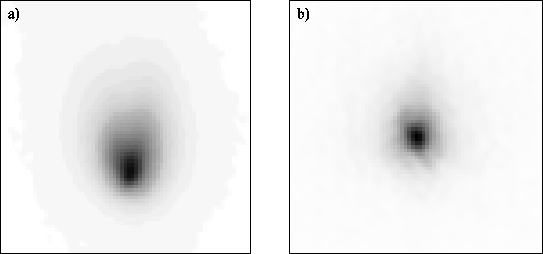
the night of 2003 June 29. The observations were taken through the
on M13 on
the night of 2003 June 29. The observations were taken through the

 edge filter, with the long-wavelength cutoff determined by
the sensitivity limit of the CCD (as illustrated in
Figure 5.5). The
edge filter, with the long-wavelength cutoff determined by
the sensitivity limit of the CCD (as illustrated in
Figure 5.5). The  star at the bottom
of the image was used as a reference. The high dynamic range in
this image is apparent when the image contrast is stretched one
hundred fold, as demonstrated in Figure 5.25. Stars
as faint as
star at the bottom
of the image was used as a reference. The high dynamic range in
this image is apparent when the image contrast is stretched one
hundred fold, as demonstrated in Figure 5.25. Stars
as faint as  can be clearly detected above the noise. Stars
H and W from Cohen et al. (1997) have been labelled in the
image. The stars toward the top of the image have asymmetrical tails
around them. The image FWHM range from
can be clearly detected above the noise. Stars
H and W from Cohen et al. (1997) have been labelled in the
image. The stars toward the top of the image have asymmetrical tails
around them. The image FWHM range from 
 for stars
at the bottom of the image to
for stars
at the bottom of the image to  for stars
at the top. In order to confirm that this blurring did not result
from anisoplanatism, the data analysis was repeated using star
W as the reference instead of star H.
for stars
at the top. In order to confirm that this blurring did not result
from anisoplanatism, the data analysis was repeated using star
W as the reference instead of star H.
|
 |
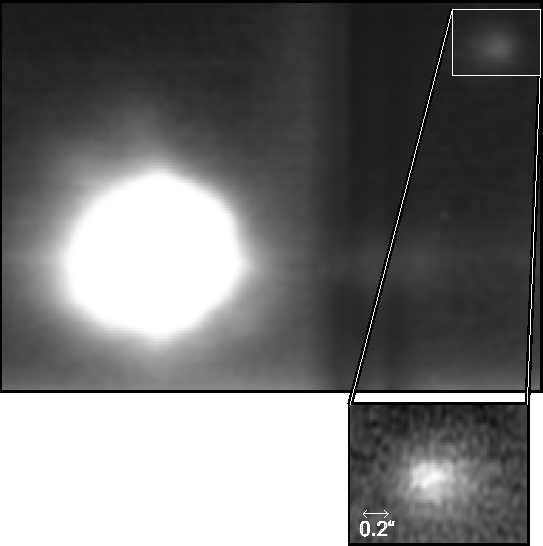
The dynamic range of Lucky Exposures is highlighted in a more quantative manner by
Figure 5.27. This data on Gliese 569 was taken at
a frame rate of  on 2002 July 25 (as listed in
Table 5.3). At the
on 2002 July 25 (as listed in
Table 5.3). At the  observing wavelength the
magnitude difference is
observing wavelength the
magnitude difference is  , and yet the faint companion is easily
detected with little light contamination from the primary
, and yet the faint companion is easily
detected with little light contamination from the primary 
 away. The data were taken through high Saharan dust extinction, and
there is insufficient signal-to-noise to separate the binary
components.
away. The data were taken through high Saharan dust extinction, and
there is insufficient signal-to-noise to separate the binary
components.
 |
Bob Tubbs 2003-11-14





