


Geometric algebra is useful to a physicist because it
automatically incorporates the structure of the world we inhabit, and
accordingly provides a natural language for physics. One of the
clearest illustrations of its power is the way in
which it deals with reflections and rotations. The key to
this approach is a theorem due to Hamilton[25]:
given any unit vector n ( , we can resolve an arbitrary
vector x into parts parallel and perpendicular to n:
, we can resolve an arbitrary
vector x into parts parallel and perpendicular to n:  . These components are identified
algebraically through their commutation properties:
. These components are identified
algebraically through their commutation properties:

The vector  can therefore be written
-nxn. Geometrically, the transformation
can therefore be written
-nxn. Geometrically, the transformation  represents a reflection in a plane perpendicular to n. To
make a rotation we need two of these reflections:
represents a reflection in a plane perpendicular to n. To
make a rotation we need two of these reflections:

where  is called a `rotor'. We call
  the `reverse' of R, because it is obtained by reversing the order
of all geometric products. The rotor is even (i.e. viewed as a multivector
it contains
only even-grade elements), and is unimodular, satisfying
the `reverse' of R, because it is obtained by reversing the order
of all geometric products. The rotor is even (i.e. viewed as a multivector
it contains
only even-grade elements), and is unimodular, satisfying  .
.
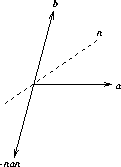
Figure 1: A rotation composed of two reflections
As an example, let us rotate the unit vector a into another unit vector b, leaving all vectors perpendicular to a and b unchanged (a simple rotation). We can accomplish this by a reflection perpendicular to the unit vector which is half-way between a and b (see Figure 1):

This reflects a into -b, which we correct by a second reflection perpendicular to b. Algebraically,

which represents the simple rotation in the  plane.
Since
plane.
Since  , we define

so that the rotation is written

which is a `bilinear' transformation of a. The inverse transformation is

The bilinear transformation of vectors  is a very general way of handling rotations. In deriving this
transformation the dimensionality
of the space of vectors was at no point specified.
As a result, the
transformation law works for all spaces, whatever
dimension. Furthermore, it works for all types of geometric
object, whatever grade. We can see this by considering the
product of vectors
is a very general way of handling rotations. In deriving this
transformation the dimensionality
of the space of vectors was at no point specified.
As a result, the
transformation law works for all spaces, whatever
dimension. Furthermore, it works for all types of geometric
object, whatever grade. We can see this by considering the
product of vectors

which holds because  .
.
As an example, consider a 2-dimensional rotation:

A rotation by angle  is performed by the even element (the
equivalent of a complex number)
is performed by the even element (the
equivalent of a complex number)

As a check:

and

The bilinear transformation is much easier to use than the one-sided rotation matrix, because the latter becomes more complicated as the number of dimensions increases. Although this is less evident in two dimensions, in three dimensions it is obvious: the rotor
represents a rotation of  radians about the axis along the direction
of
radians about the axis along the direction
of  . If required, we can decompose rotations into Euler angles
 , the explicit form being

We now examine the composition of rotors in more detail. In three dimensions, let the rotor R transform the unit vector along the z-axis into a vector s:
Now rotate the s vector into another vector  , using a rotor
 . This requires

so that the transformation is characterised by

which is the (left-sided) group combination rule for rotors. Now
suppose that we start with s and make a rotation of  about the z-axis, so that
  returns to s. What happens
to R is surprising; using (3.13) above, we see that
returns to s. What happens
to R is surprising; using (3.13) above, we see that

This is the behaviour of spin- particles in quantum mechanics,
yet we have done nothing quantum-mechanical; we have merely built up
rotations from reflections.
particles in quantum mechanics,
yet we have done nothing quantum-mechanical; we have merely built up
rotations from reflections.
How can this be? It turns out[24] that it is possible
to represent a Pauli spinor  (a 2-component complex spinor)
as an arbitrary even element
(a 2-component complex spinor)
as an arbitrary even element  (four real components) in the
geometric algebra of 3-space pauli1. Since
(four real components) in the
geometric algebra of 3-space pauli1. Since  is a
positive-definite scalar in the Pauli algebra we can write
is a
positive-definite scalar in the Pauli algebra we can write

Thus, the Pauli spinor  can be seen as a (heavily
disguised) instruction to rotate and dilate. The identification of a
rotor component in
can be seen as a (heavily
disguised) instruction to rotate and dilate. The identification of a
rotor component in  then explains the double-sided action of
spinors on observables. The spin-vector observable, for example, can
be written in geometric algebra as
then explains the double-sided action of
spinors on observables. The spin-vector observable, for example, can
be written in geometric algebra as

which has the same form as equation (3.15). This identification of quantum spin with rotations is very satisfying, and provides much of the impetus for David Hestenes' work on Dirac theory.
A problem remaining is what to call an arbitrary even element
 . We shall call it a spinor, because the space of even
elements forms a closed algebra under the left-sided action of the
rotation group:
. We shall call it a spinor, because the space of even
elements forms a closed algebra under the left-sided action of the
rotation group:  gives another even element.
This accords with the usual abstract definition of spinors from group
representation theory, but differs from the column vector definition
favoured by some authors[26].
gives another even element.
This accords with the usual abstract definition of spinors from group
representation theory, but differs from the column vector definition
favoured by some authors[26].

