ARCADE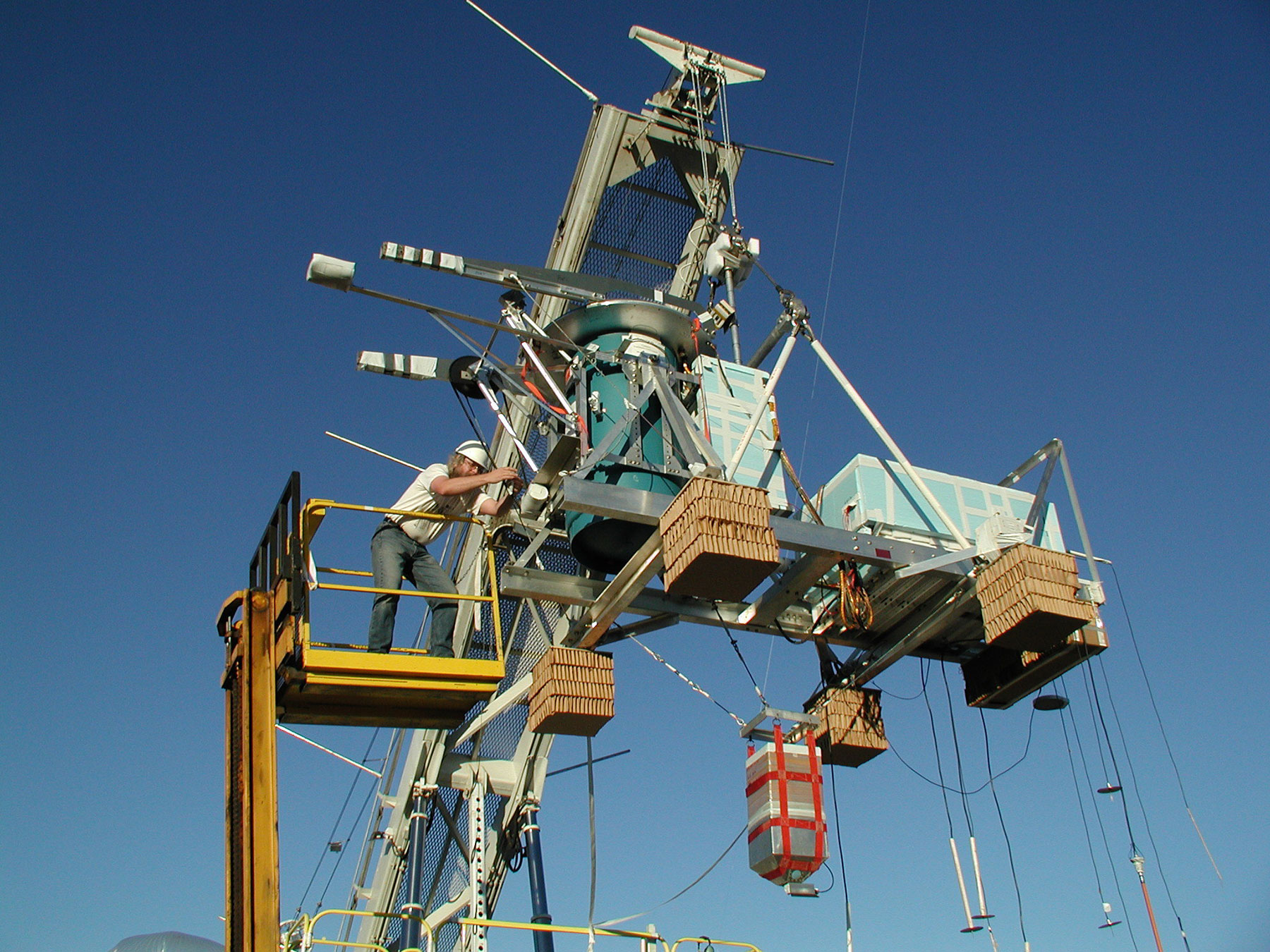
ARCADE1 - Dale Fixsen on the flight line
more...
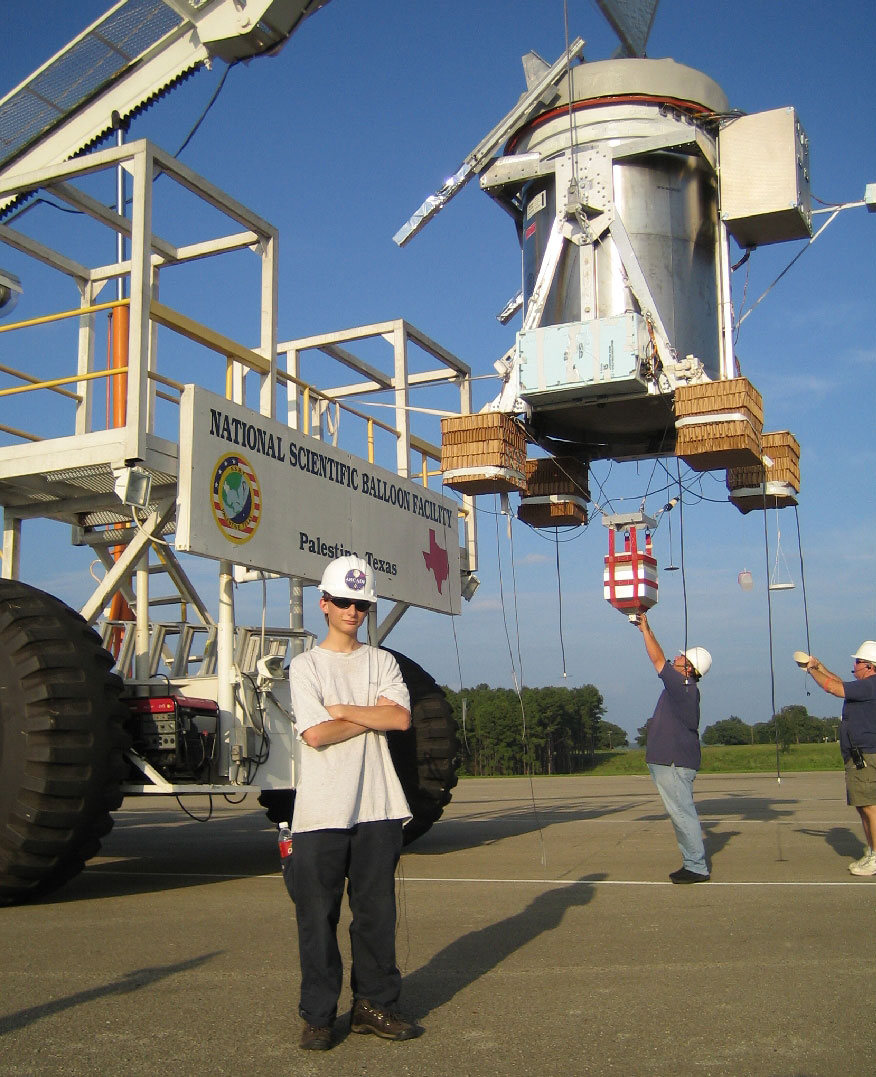
ARCADE2 - ARCADE payload in 2005 with intern Luke Lowe for scale. The 2005 flight was the first flight with the full 7-channel instrument.
more...
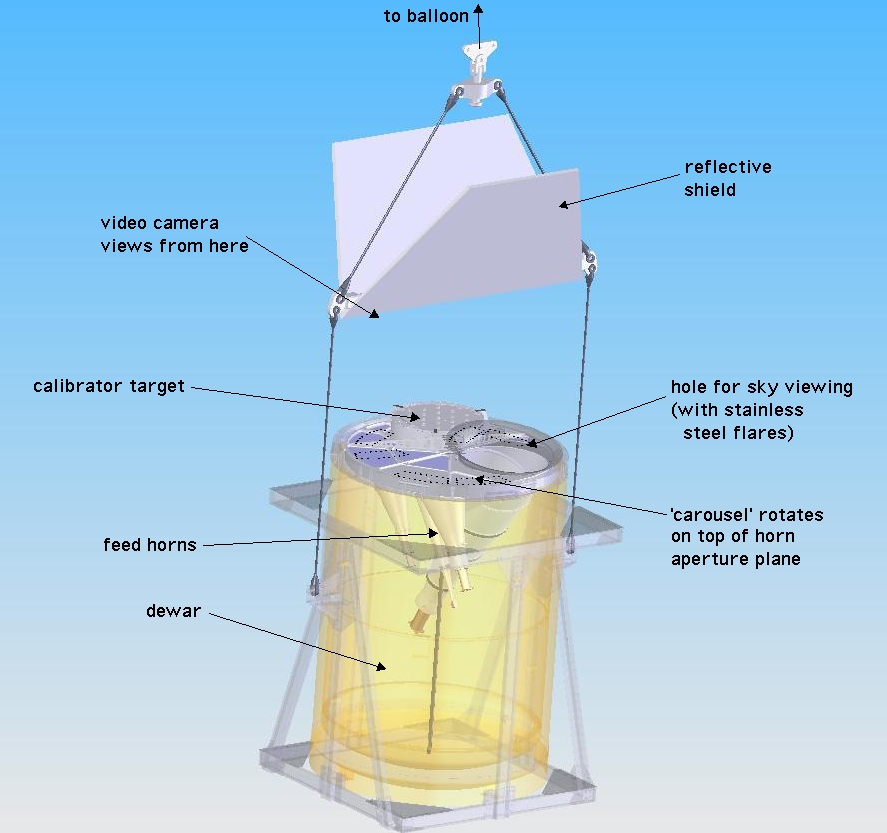
Drawing of the ARCADE payload. The instrument is mounted inside a large (5 feet in diameter, 8 feet tall) bucket dewar. The antennas attach to the top of the dewar and are tilted to point 30 degrees from vertical. A carousel covers the top and can rotate to allow each antenna in turn to view the sky through a sky port. A video camera attached to the reflective shield can view the antennas from its vantage point above and to the side of the dewar mouth.
more...
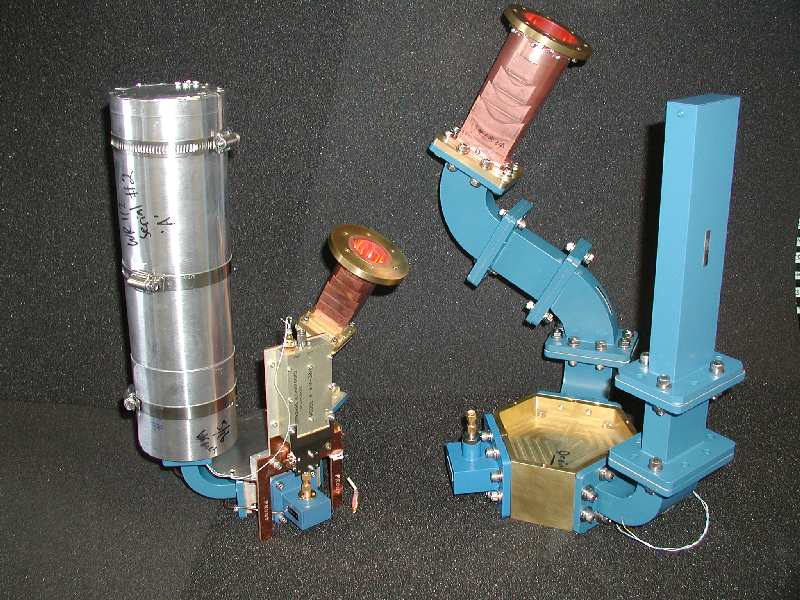
ARCADE2 - consists of a set of seven Dicke-switched cryogenic radiometers covering the poorly measured centimeter band between full-sky surveys at radio frequencies (f < 3 GHz) and the FIRAS millimeter and sub-mm measurements (f > 60 GHz).
more...
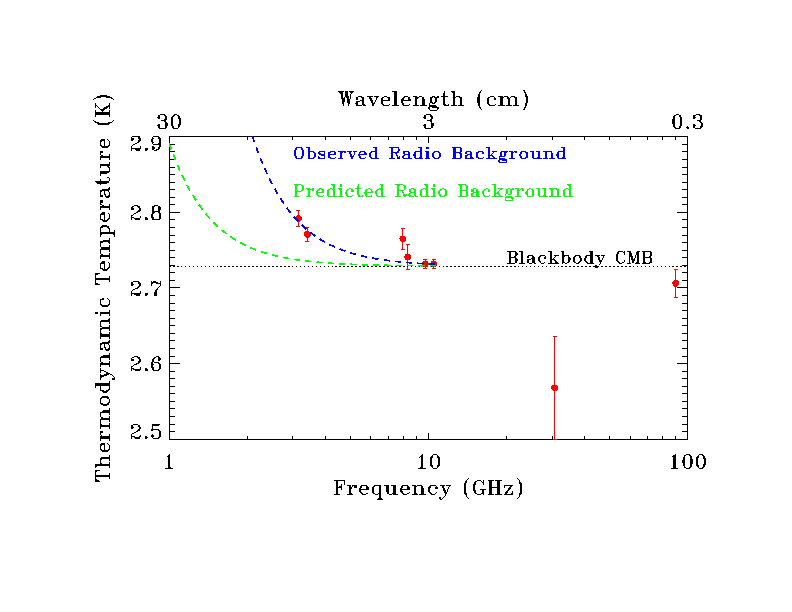
ARCADE2 - The extragalactic temperature measured by ARCADE from the 2006 flight. The ARCADE data are consistent with a blackbody CMB spectrum with temperature To = 2.729 +/- 0.004 K.
more...
Images Courtesy of the ARCADE TeamOverviewARCADE (Absolute Radiometer for Cosmology, Astrophsyics, and Diffuse Emission) consisted of a set of precision radiometers, cooled to nearly absolute zero, and carried to an altitude of over 35 km (21 miles) by a scientific research balloon. ARCADE was designed to measure the tiny heating of the early Universe by the first generation of stars and galaxies to form after the Big Bang. It also searched for the signal of relic particle decays or annihilation. ARCADE1 was flown in 2001 and 2003. This instrument was intended primarily as a pathfinder, with two frequency channels at 10 and 30 GHz and beam FWHM of 16 degrees. ARCADE2, the second generation instrument, flew in 2005 and 2006. There were seven observing channels: six with FWHM 12 deg at 3, 5, 8, 10, 30, and 90 GHz, and an additional channel at 30 GHz with a much narrower beam to provide a cross-check on emission in the antenna sidelobes In the 2006 flight, no data was taken at 5 GHz (Dicke switch failure) and the noise level of the narrow-beam 30 GHz channel limited its usefulness. Scientific results from ARCADE2 include 2 sigma upper limits to CMB spectral distortions (chemical potential μ and free-free Yff), and detection of extragalactic radio emission beyond the expected contribution from discrete radio sources and 2.7 K CMB radiation. Experiment Information:
The archived ARCADE website can be viewed HERE. |