


The first stellar images from an array of separated telescopes were made with
COAST in September 1995 (Baldwin et al. 1996). The observations of
Capella used three telescopes in the array, giving three interferometer
baselines and one closure phase, the minimum necessary for unambiguous imaging.
The angular resolution of 20 milliarcseconds clearly separates the two
components but does not resolve the individual stellar disks ( mas).
The quality of the reconstructed images (fig 10) is excellent,
with a dynamic range of 50:1. There is also very close agreement between the
observed separations and position angles and the predictions from the best
available orbit for Capella. The achievement of this long-standing goal of high
angular resolution imaging is important in establishing that the whole process
of observation and image reconstruction works with a high degree of
reliability.
mas).
The quality of the reconstructed images (fig 10) is excellent,
with a dynamic range of 50:1. There is also very close agreement between the
observed separations and position angles and the predictions from the best
available orbit for Capella. The achievement of this long-standing goal of high
angular resolution imaging is important in establishing that the whole process
of observation and image reconstruction works with a high degree of
reliability.
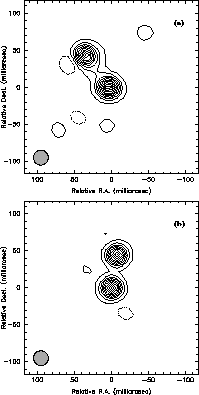
Figure 10:
Image reconstructions of Capella, from data obtained on the nights of the
13th (top) and 28th (bottom) September 1995. In each plot the contour levels are
plotted from -5% to 95% of the peak flux with an interval of 10%. The
20mas restoring beam is shown in the bottom left of each panel. Because
of the  plane coverage, the image resolution is lower in
PA
plane coverage, the image resolution is lower in
PA  than along the perpendicular direction.
Imaging of a resolved stellar disk, which is more difficult because of the low fringe visibilities at all the larger baselines, was also realised in the observations of Betelgeuse described in Section 1.4. Fringe visibilities as low as 1 per cent were measured and the dynamic range of the image was again very good. The limiting factor in the quality of the image was the relatively poor (u,v) coverage obtained using only three telescopes. A major effort has therefore gone into the commissioning of the fourth telescope and its incorporation into the array for regular observations. Such observations giving 6 interferometer baselines and three closure phases have now been made successfully.
A further important aspect of the instrumental performance is the limiting magnitude which can be reached with COAST. The faintest star observed so far is of magnitude +6.0, for which a signal-to-noise ratio of 300 was obtained in a 100s observation. This suggests a limiting magnitude for COAST of about +10, when the improved acquisition system has been implemented, which is just that anticipated in the original COAST proposal.
Construction of the CCD-based detector system for obtaining spectrally resolved imaging over the band 650--950nm has gone ahead following its funding in 1995. Its mode of operation and its relevance to fringe tracking has been discussed by Lawson (1997). Commissioning and assessment of its performance is in progress.