


Next: Temporal properties of the Up: Observational results with single Previous: Observational results with single Contents
 Aquilae listed in
Table 3.2 were analysed using the approach described in
Figure 3.13. The best
Aquilae listed in
Table 3.2 were analysed using the approach described in
Figure 3.13. The best  of exposures were selected
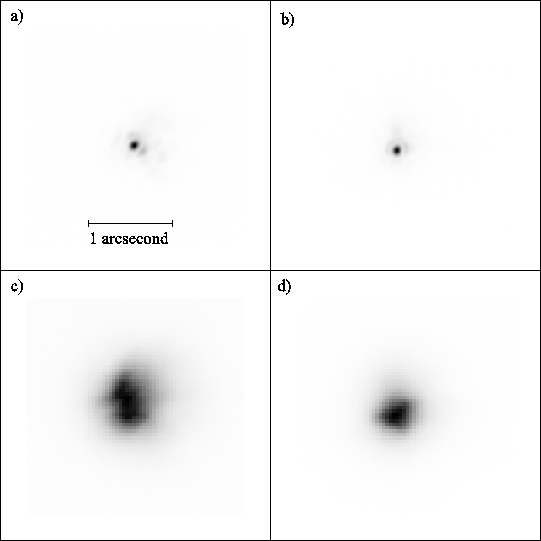
and co-added - the resulting images for V656 Herculis and
Aquilae are shown in Figures 3.14a and
3.14b. Shown beneath are the average (seeing-limited)
images from the same data in Figures 3.14c and
3.14d, representing conventional long exposures. It is
possible that telescope tracking errors might have contributed to the
asymmetry in the long exposure image of V656 Herculis, but it is
difficult to distinguish these errors from the random motion due to
the atmosphere.
of exposures were selected
and co-added - the resulting images for V656 Herculis and
Aquilae are shown in Figures 3.14a and
3.14b. Shown beneath are the average (seeing-limited)
images from the same data in Figures 3.14c and
3.14d, representing conventional long exposures. It is
possible that telescope tracking errors might have contributed to the
asymmetry in the long exposure image of V656 Herculis, but it is
difficult to distinguish these errors from the random motion due to
the atmosphere.
The image selection method provides images with FWHM of 
 for V656 Herculis and
  for Aquilae,
a very substantial improvement over the FWHM of the conventional
astronomical images (
for Aquilae,
a very substantial improvement over the FWHM of the conventional
astronomical images ( and
and  respectively). In the Lucky Exposures images the first Airy ring is visible
(although it is not uniform around the stars). In both images the total
flux beyond the first Airy ring is relatively small. If these PSF
were available for imaging complex fields, extremely high image
resolution and quality would be obtained.
respectively). In the Lucky Exposures images the first Airy ring is visible
(although it is not uniform around the stars). In both images the total
flux beyond the first Airy ring is relatively small. If these PSF
were available for imaging complex fields, extremely high image
resolution and quality would be obtained.
 |
Bob Tubbs 2003-11-14


