


Next: Exposure selection Up: Short exposure optical imaging Previous: The outer and inner Contents
 entirely - this corresponds
to the case where atmospheric refractive index perturbations are only
found very close to the aperture plane of the telescope. This is
achieved in the simulations simply by setting:
entirely - this corresponds
to the case where atmospheric refractive index perturbations are only
found very close to the aperture plane of the telescope. This is
achieved in the simulations simply by setting:
The effect of the finite aperture size of the telescope can be
simulated by setting the wavefront amplitude to zero everywhere in the
aperture plane except where the light path to the primary mirror is
unobstructed. This can be achieved most easily by defining a function
 which describes the effect of the telescope
aperture plane coverage on the wavefronts in the same way that the
effect of the atmosphere is described by
. The value of
will be zero beyond the edge of the primary
mirror and anywhere the primary is obstructed, but unity
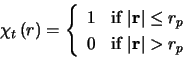
elsewhere. For the simple case of a circular primary mirror of radius
which describes the effect of the telescope
aperture plane coverage on the wavefronts in the same way that the
effect of the atmosphere is described by
. The value of
will be zero beyond the edge of the primary
mirror and anywhere the primary is obstructed, but unity
elsewhere. For the simple case of a circular primary mirror of radius
 without secondary obstruction:
Phase perturbations introduced into the wavefronts by
aberrations in the telescope can be described by a function
 in similar way, resulting in wave-function
 given by:
I will begin with the simple case of a telescope which is free of
optical aberrations observing in a narrow wavelength band. The
perturbed wave-function reaching the telescope aperture for this case
is given by setting
 in
Equation 1.8. Combined with
Equation 1.6 this gives:
in
Equation 1.8. Combined with
Equation 1.6 this gives:
For the simulations a long-period pseudo-random number generator was
used to produce two-dimensional arrays containing discrete values of
 , having the second order structure
function defined by Equation 1.4, using a standard
algorithm provided by Keen (1999). The time evolution of
was ignored, as I was interested in the
instantaneous imaging performance (the case for short
exposures). Arrays of
, having the second order structure
function defined by Equation 1.4, using a standard
algorithm provided by Keen (1999). The time evolution of
was ignored, as I was interested in the
instantaneous imaging performance (the case for short
exposures). Arrays of
 were then
generated corresponding to the wave-function provided by a distant
point source after passing through the atmospheric phase perturbations
and the telescope aperture using Equation
1.9. These arrays were Fourier transformed
using a standard Fast Fourier Transform (FFT) routine to provide
images of the point source as seen through the atmosphere and
telescope. The image of a point source through an optical system is
called the point-spread-function (PSF) of the optical system. For our simple optical
arrangement with phase perturbations very close to the aperture plane,
the response of the system to extended sources of incoherent light is
simply the convolution of the PSF with a perfect image of the
extended source.
were then
generated corresponding to the wave-function provided by a distant
point source after passing through the atmospheric phase perturbations
and the telescope aperture using Equation
1.9. These arrays were Fourier transformed
using a standard Fast Fourier Transform (FFT) routine to provide
images of the point source as seen through the atmosphere and
telescope. The image of a point source through an optical system is
called the point-spread-function (PSF) of the optical system. For our simple optical
arrangement with phase perturbations very close to the aperture plane,
the response of the system to extended sources of incoherent light is
simply the convolution of the PSF with a perfect image of the
extended source.
Figure 1.3 shows simulated PSFs for three
atmospheric realisations having the same  and image scales but
with different telescope diameters. There are two distinct regimes for
the cases of large (diameter
and image scales but
with different telescope diameters. There are two distinct regimes for
the cases of large (diameter  ) and small (
 )
telescopes. Figure 1.3a is a typical PSF from a
telescope of diameter
)
telescopes. Figure 1.3a is a typical PSF from a
telescope of diameter  . The image is broken into a large
number of speckles, which are randomly distributed over a circular
region of the image with angular diameter
. The image is broken into a large
number of speckles, which are randomly distributed over a circular
region of the image with angular diameter
 , where
  represents the
wavelength. With the slightly smaller aperture shown in Figure
1.3b the individual speckles are larger - this is
because the typical angular diameter for such speckles is
represents the
wavelength. With the slightly smaller aperture shown in Figure
1.3b the individual speckles are larger - this is
because the typical angular diameter for such speckles is
 , equal to the diameter of the PSF in the
absence of atmospheric phase perturbations for a telescope of the same
diameter
, equal to the diameter of the PSF in the
absence of atmospheric phase perturbations for a telescope of the same
diameter  (i.e. a diffraction-limited PSF). For the small
aperture size shown in Figure 1.3c the shape of
the instantaneous PSF deviates little from the diffraction-limited
PSF given by a telescope of this diameter. The first Airy ring is
partially visible around the central peak.
(i.e. a diffraction-limited PSF). For the small
aperture size shown in Figure 1.3c the shape of
the instantaneous PSF deviates little from the diffraction-limited
PSF given by a telescope of this diameter. The first Airy ring is
partially visible around the central peak.
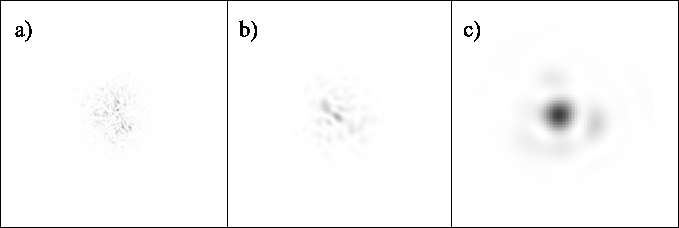 |
Real astronomical images of small fields obtained through the atmosphere will correspond to an image of the sky brightness distribution convolved with the PSF for the telescope and atmosphere. The perturbations introduced by the atmosphere change on timescales of a few milliseconds (known as the atmospheric coherence time). If the exposure time for imaging is shorter than the atmospheric coherence time, and the telescope is free of optical aberrations, then Figures 1.3a--c will be representative of the typical PSFs observed. The random distribution of speckles found in the short exposure PSFs of Figures 1.3a and 1.3b will have the effect of introducing random noise at high spatial frequencies into the images, making individual short exposures such as these of little direct use for high resolution astronomy. Figure 1.3c is dominated by a relatively uniform bright core, and as such will provide images with relatively high signal-to-noise. Unfortunately the broad nature of the PSF core severely limits the image resolution which can be obtained with such a small aperture.
Bob Tubbs 2003-11-14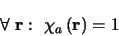
![\begin{displaymath}
\psi_{p}' \left(\mathbf{r}\right) = \left ( \chi_{a} \left(\...
...r}\right) \right ] } \right ) \psi_{0} \left(\mathbf{r}\right)
\end{displaymath}](img166.png)



