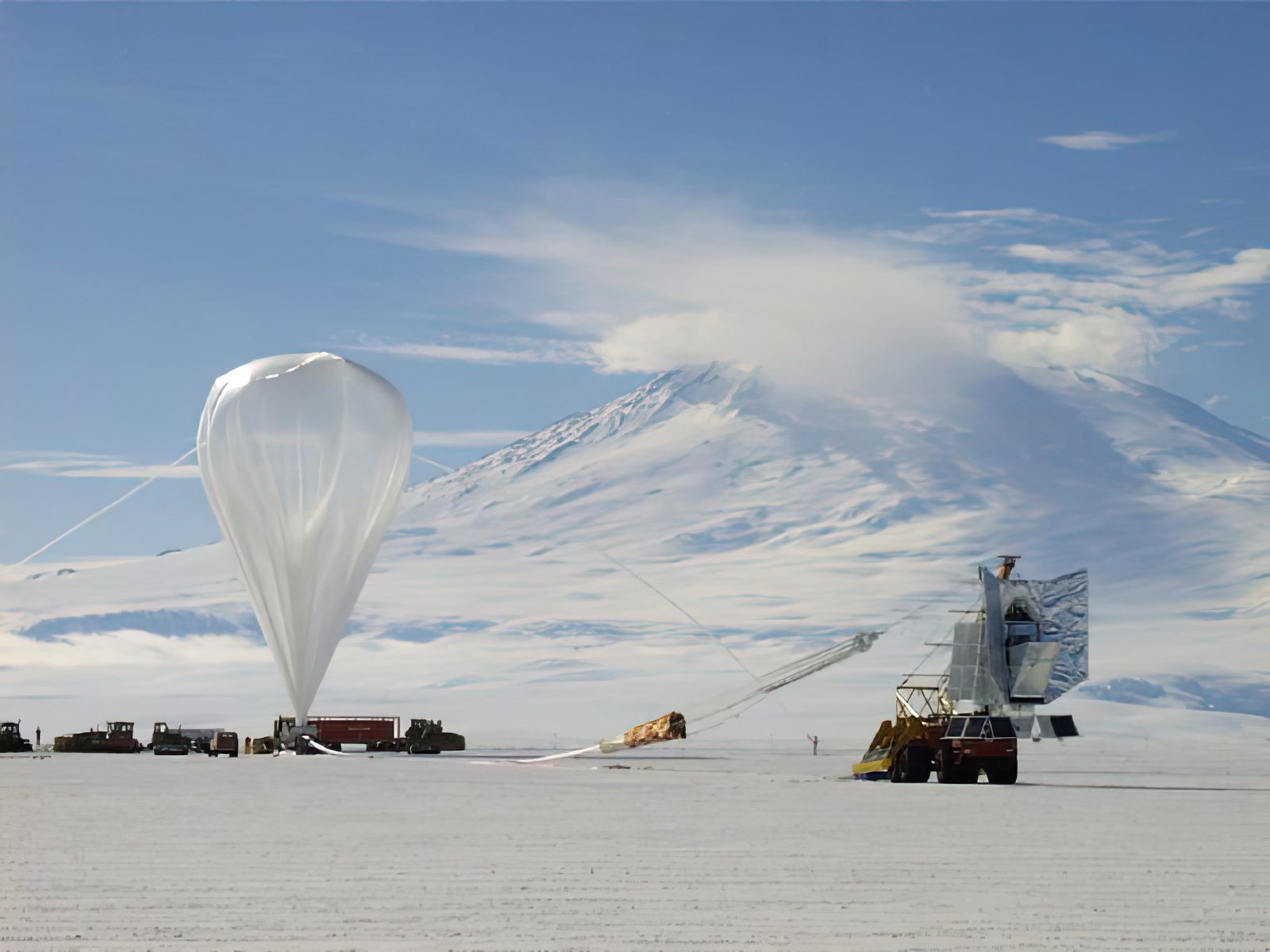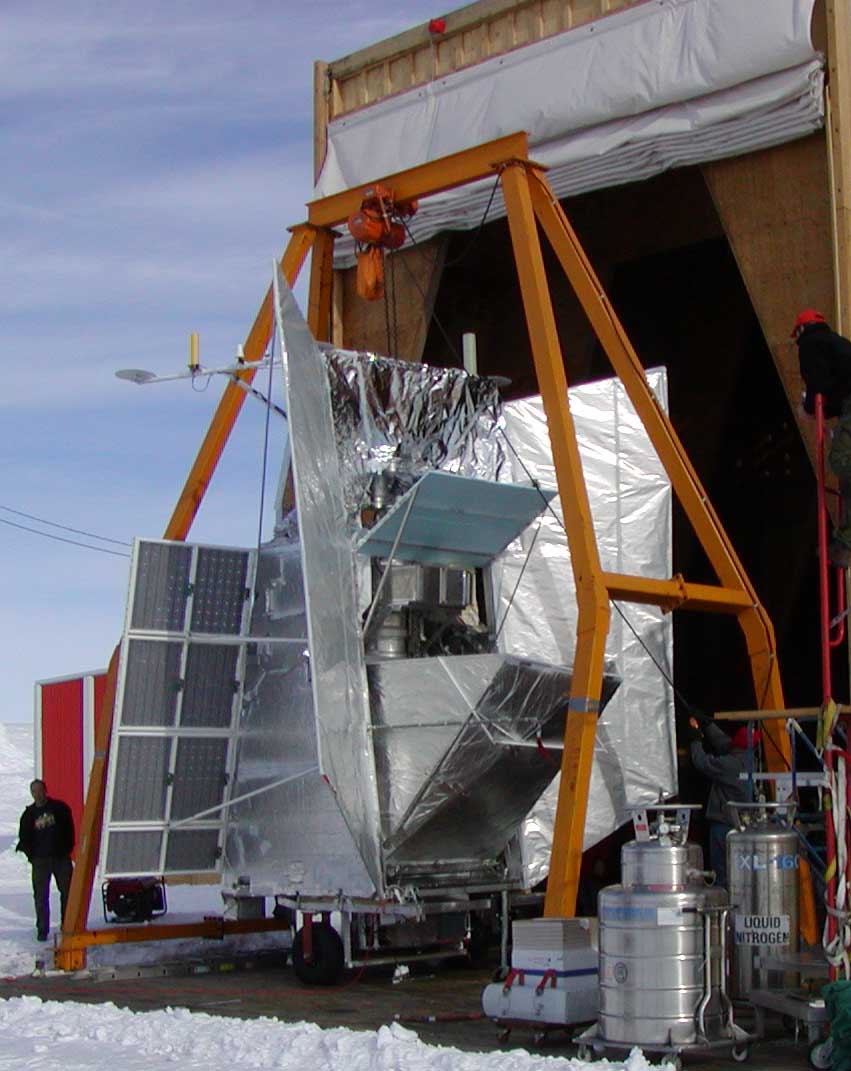
The B2K payload, during integration in McMurdo - Dec.2002
more...
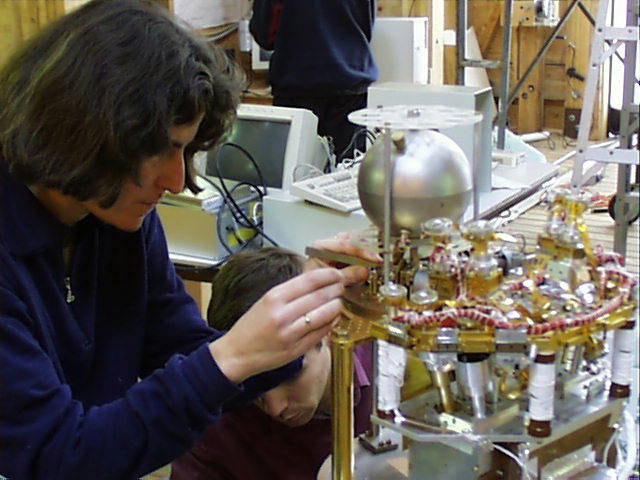
The heart of the cryogenic system is a large 3He refrigerator, cooling all the focal plane at 270 mK for 15 days, and recyclable in flight.
more...
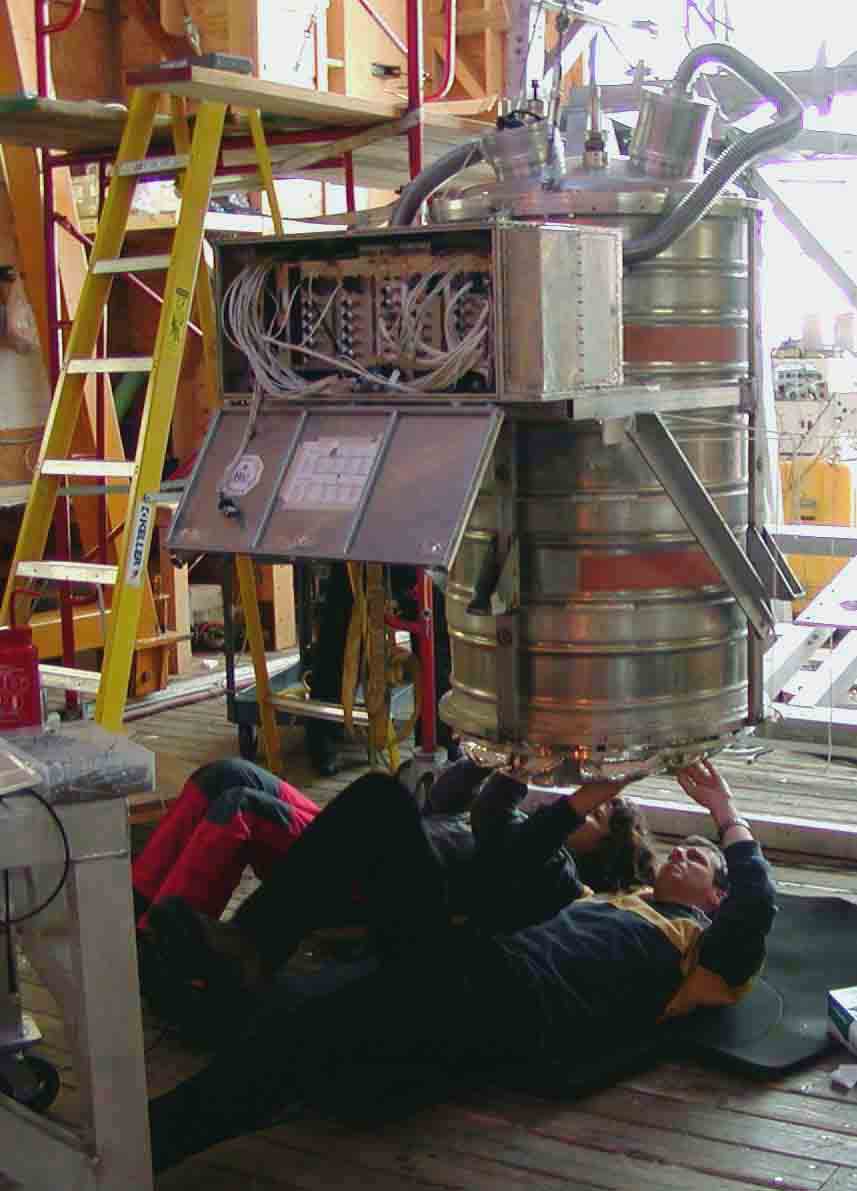
The detectors, 3He fridge and reimaging optics are all contained inside a large dewar with 70 liters of liquid nitrogen and 60 liters of liquid helium.
more...
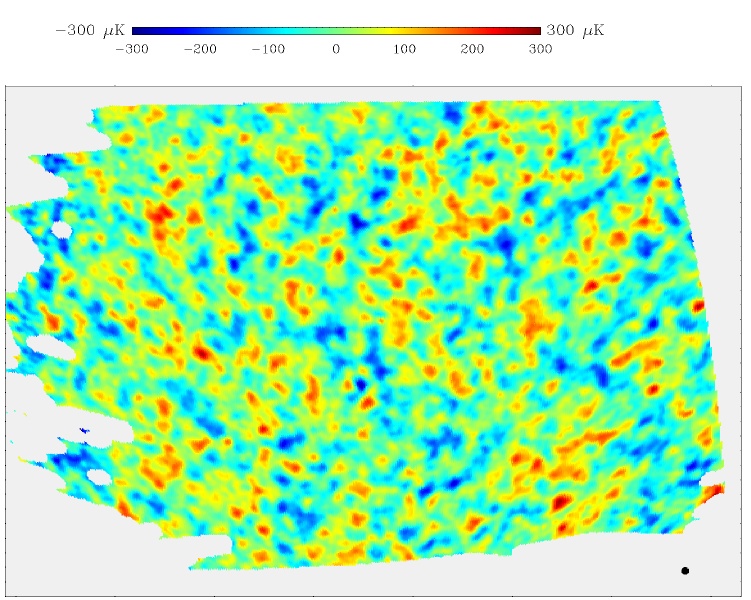
Temperature Fluctuations in the Cosmic Background Radiation, as measured by BOOMERanG in 1998.
BOOMERanG (Balloon Observations Of Millimetric Extragalactic Radiation and Geophysics) was a balloon-borne instrument which imaged the Microwave Background Radiation in three or four bands, or colors, at wavelengths of about one-two millimeters. This is a much longer wavelength of light than our eyes can see, but a much shorter wavelength than the light used by microwave ovens, or by your radio.
BOOMERanG flew multiple times with different band configurations.
Flights in 1997 and 1998 had 4 bands centered on 90, 150, 240, and 410 GHz.
The third (2003) flight included a reconfigured instrument with three frequency bands and polarization sensitive bolometers. In order to maximize sensitivity to the CMB while being able to distinguish the foreground emission, the three bands were chosen to be centered on 145, 245 and 345 GHz. The 2003 flight and associated data release are often referred to as BOOMERanG-03 or B03, and the payload itself shorthanded as B2K.
The BOOMERanG Balloon balloon flights used high altitude winds, which circulate around the South Pole during December and January, to carry the payload in a broad circle at about 77 degrees south latitude. Journeys took about two weeks, and the winds returned the payload to the vicinity of McMurdo Station.
Experiment Information:
Experiment Date Range in Years: 1997 - 2003
Frequency (GHz): 90 - 420
l-min: 25
l-max: 1025
The archived BOOMERanG website can be viewed HERE.