CAPMAP
May 2001 - Crawford Hill Receiver - side view.
more...
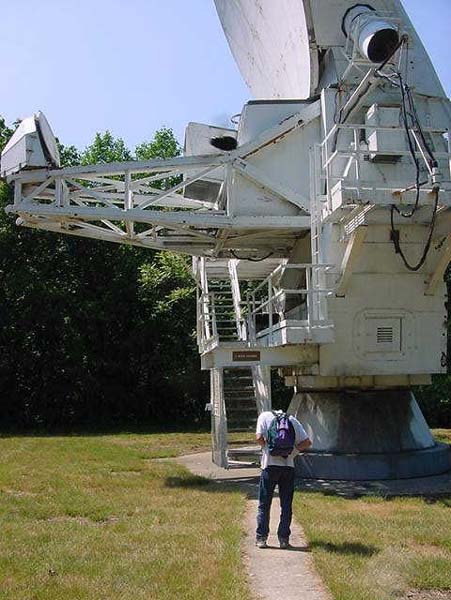
May 2001 - Crawford Hill Receiver - ground view.
more...
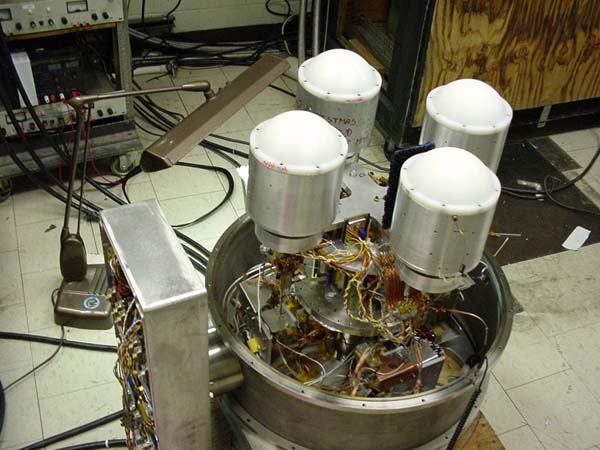
Sept 2002 - First CAPMAP03 dewar integration.
more...
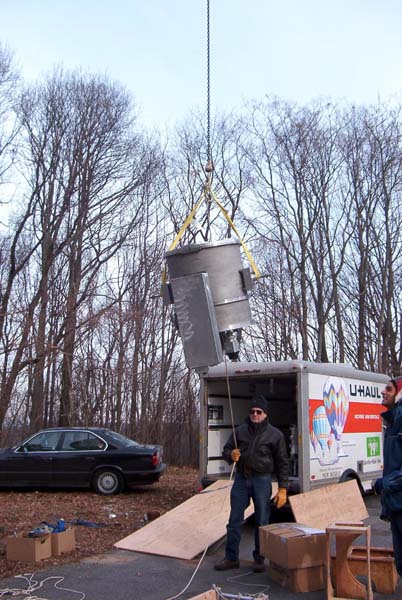
Jan 2003 - Deployment of the first CAPMAP03 dewar.
more...
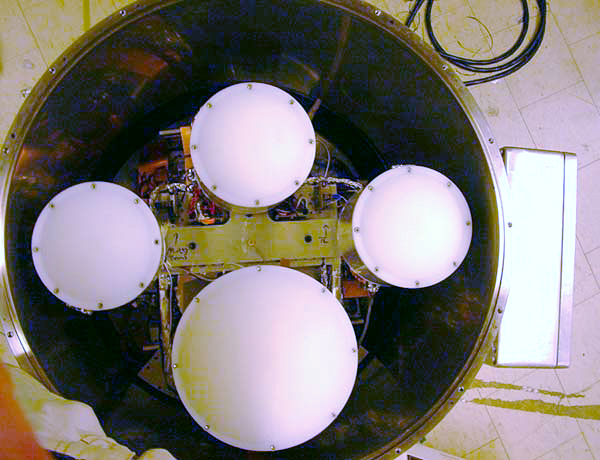
Jan 2004 - CAPMAP04 lenses with the new anti-reflection grooving in place.
more...
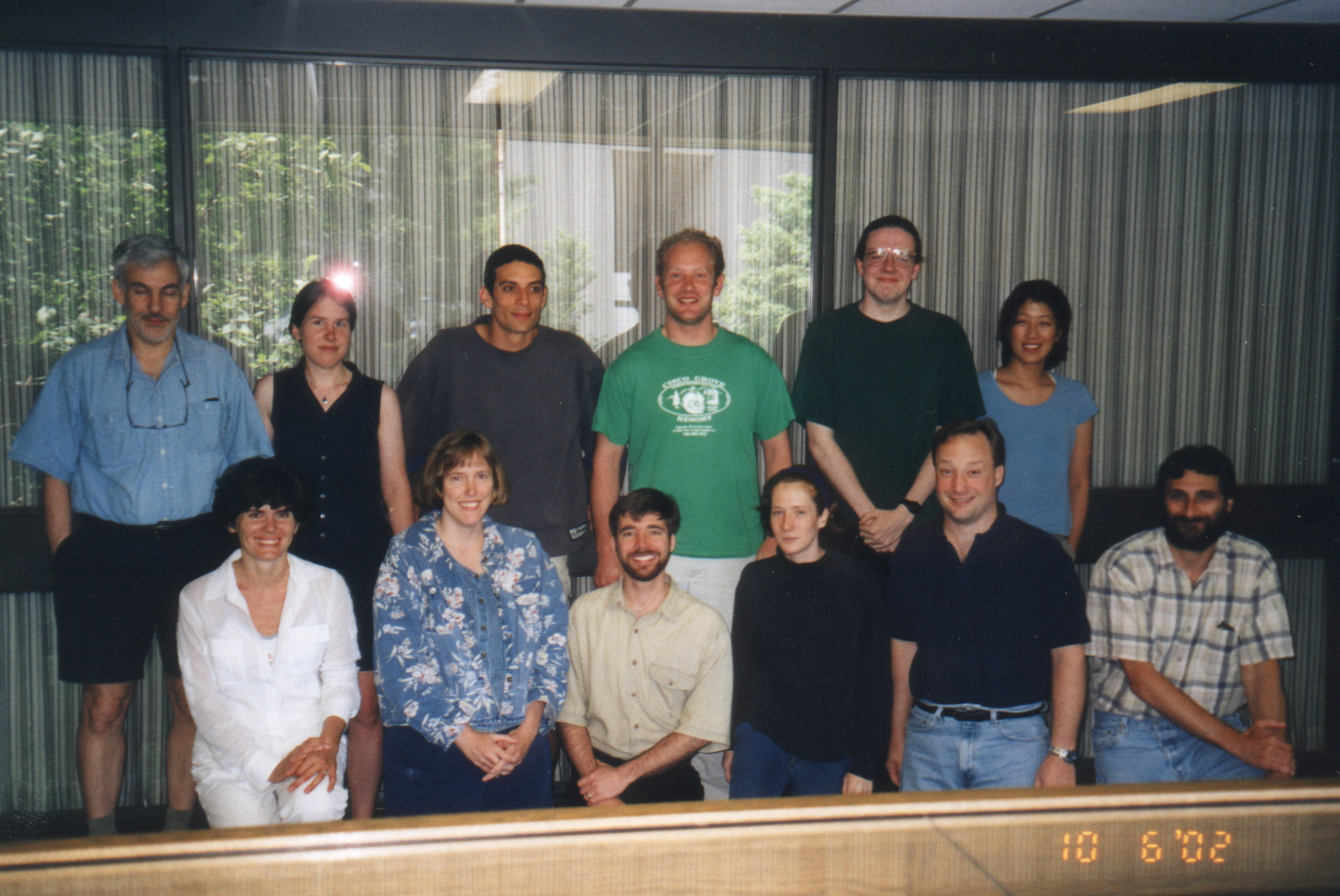
June 2002 - The CAPMAP Collaboration Team
more...
Images Courtesy of the CAPMAP Team/Princeton UniversityOverviewCAPMAP (Cosmic Anisotropy Polarization MAPper) was an experiment designed to measure the polarization of the Cosmic microwave background (CMB) radiation at small angular scales. CAPMAP employed 16 correlation polarimeters (12 at 90 GHz and four at 40 GHz) on the 7-meter Lucent Technologies telescope in Crawford Hill, New Jersey. The resulting beam sizes were 3.3 arcmin (90 GHz) and 6.5 arcmin (40 GHz): small compared to most other CMB polarization experiments in operation at the time (except for CBI). A prototype CAPMAP system with four 90 GHz receivers measured the sky during the winter of 2002-2003. The final dataset was obtained was obtained in winter 2004-2005. This the data hosted by LAMBDA The Crawford Hill telescope, located in Holmdel, NJ, scanned a one degree "cap" of sky around the North Celestial Pole (NCP) to measure the polarization of the cosmic microwave background radiation (CMB). CAPMAP used this 7-meter off-axis Cassegrain antenna to observe radiation at 3 mm wavelengths. The large primary dish was necessary to reach a 0.06 degree beam size and probe where the polarization was expected to peak, while mitigating the spurious effects due to 300 K radiation diffracting around the edges of the dish. After hitting the primary mirror, the radiation reflected onto a secondary hyperbolic mirror before reaching the receivers. The telescope can track objects such as other planets or the moon, which is useful for pointing and calibrating. Experiment Information:
The archived CAPMAP website can be viewed HERE. |