MAXIMA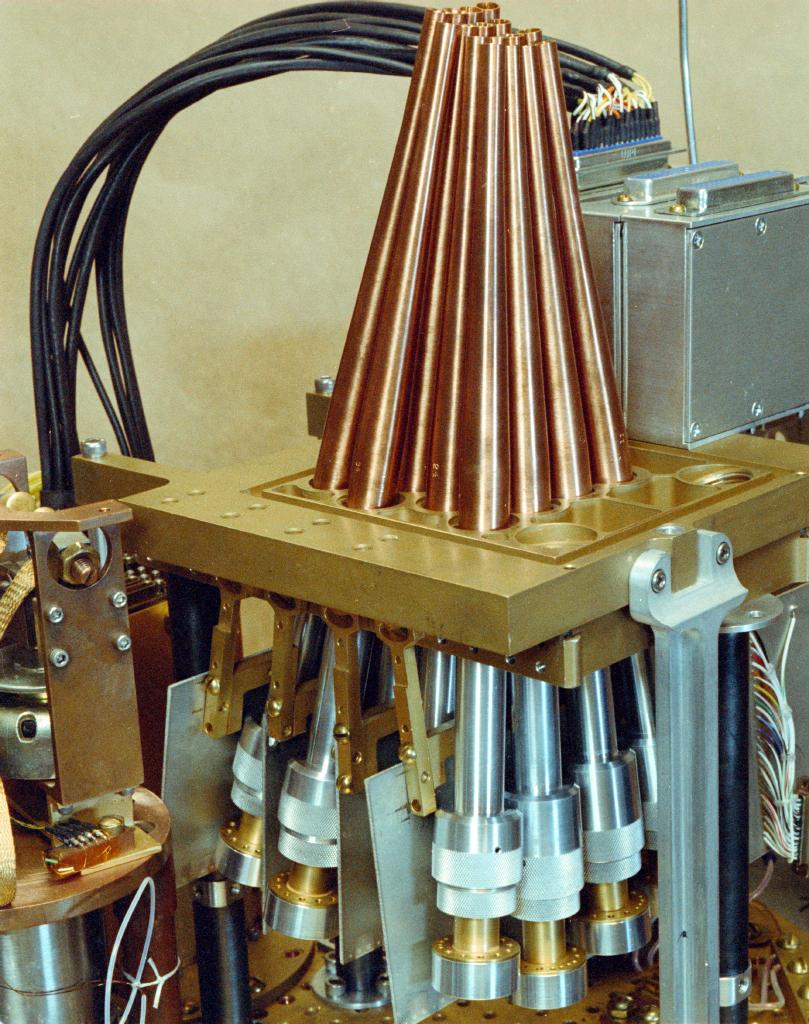
The inside of the receiver. Visible are the horns which channel light to the detectors, which are housed in the circular 'caps' near the bottom of this image. The small boxes in back are the cryogenic preamplifiers.
more...
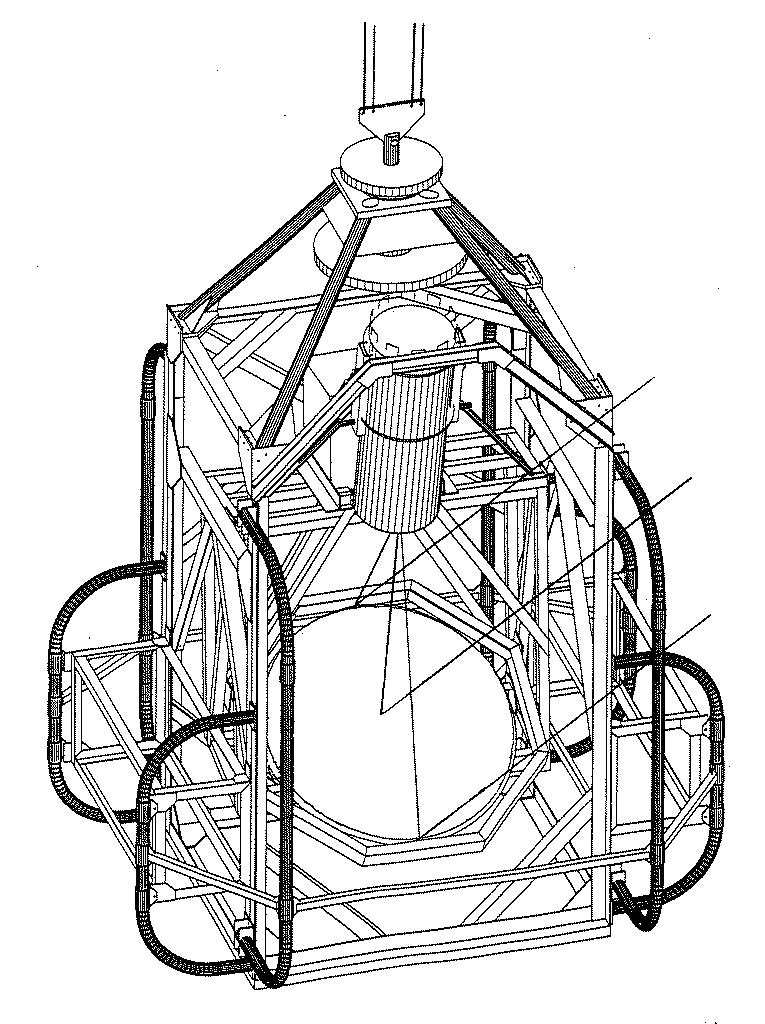
Wireframe schematic of the MAXIMA telescope and gondola.
more...
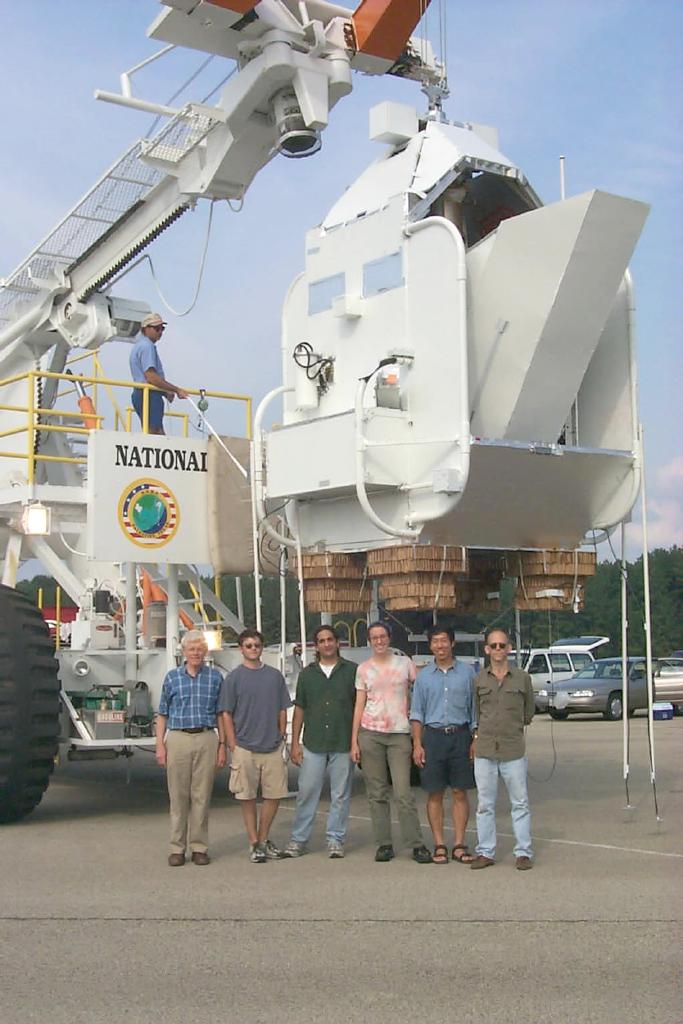
MAXIMA experimentalists posing before the June 15, 1999 launch.
more...
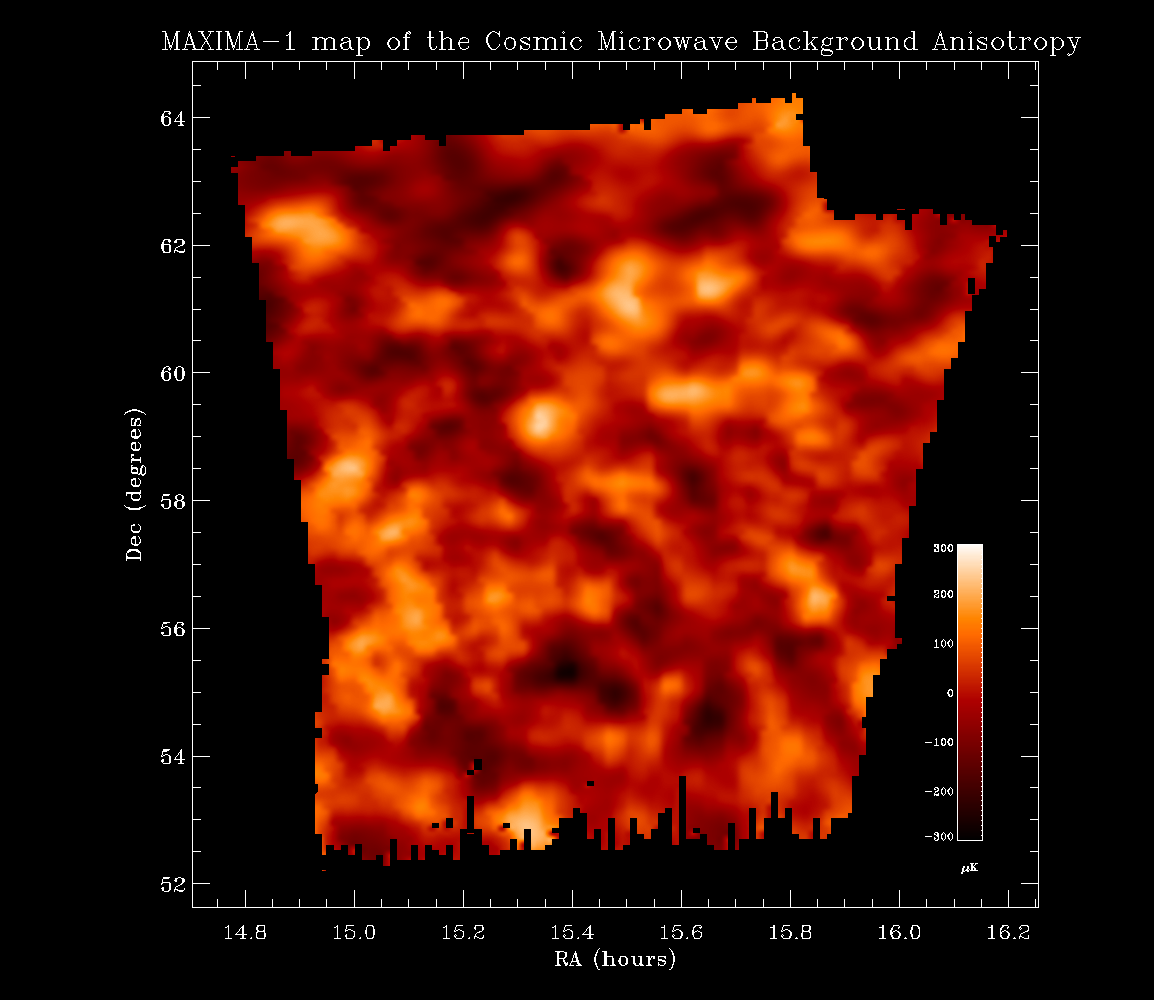
Map of CMB anisotropy with 10' resolution from MAXIMA-1. The map is made using data from three 150 GHz and one 240 GHz photometers and contains 15,000 pixels of 5' by 5'. This map is weiner filtered to smooth out pixel-scale noise.
more...
Images Courtesy of The MAXIMA CollaborationOverviewMAXIMA (Millimeter Anisotropy eXperiment IMaging Array) was a balloon-borne millimeter-wave telescope measuring the angular power spectrum of cosmic microwave background (CMB) fluctuations on angular scales of 10 arcminutes to 5 degrees. The receiver used a 16-pixel bolometer array cooled to 100 mK, with spectral bands centered at 150, 240, and 410 GHz, and 10 arcminute resolution. Systematic errors were controlled through scan strategy. Each pixel was observed on three time scales, rejecting noise isolated to any one time scale. Sky regions were scanned twice with >1 hour separation at different angles, producing a cross-hatched pattern that enables two-dimensional map reconstruction from one-dimensional scans despite low-frequency detector noise. MAXIMA's first flight in 1995 was a test flight, with a partial instrument payload. There were two subsequent flights (from Palestine, TX), fully configured for science observations. MAXIMA-1 (1998) observed 124 deg². MAXIMA-2 (1999) covered 230 deg², nearly twice the sky area of the first flight. The MAXIMA team recommended the 1998 dataset as preferred for CMB analysis and released maps, band powers, Fisher matrix and ancillary data for community use Experiment Information:
The archived MAXIMA website can be viewed HERE. |