Milano Polarimeter (MIPOL)

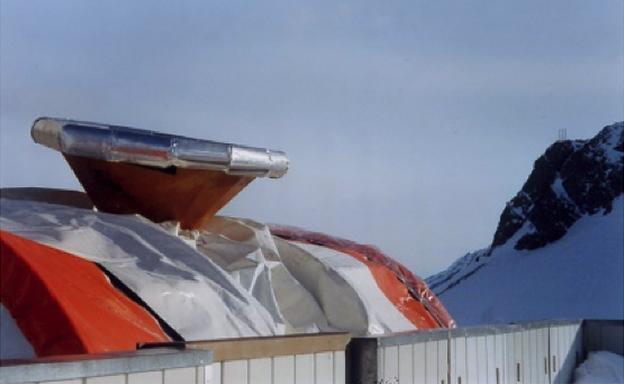
MIPOL image.

Images Courtesy of the MIPOL Science Team

The Milano Polarimeter (MIPOL) external shield protruding out of a protective structure housing the instrument, on a snowy mountain top, at the Testa Grigia Observatory in the Italian Alps.


Overview

The MIPOL (Milano Polarimeter) was a ground-based cosmological experiment specifically designed to improve constraints on circular polarization in the Cosmic Microwave Background (CMB) at 33 GHz on large angular scales. Observations of the Stokes V parameter, which characterizes circular polarization, were made from the Testa Grigia Observatory in the Italian Alps.

Circular polarization of the CMB is not expected in the standard ΛCDM cosmological model. Upper limits provide constraints on detection of primordial magnetic fields and potential parity-violating physics in the early universe.

Results from MIPOL significantly improved preexisting upper limits on CMB circular polarization by an order of magnitude at large angular scales (ranging between 5.0 × 10⁻⁴ and 0.7 × 10⁻⁴ at angular scales of 8° to 24°). The data collected by MIPOL has been valuable for comparing against modern, large-scale instruments (such as the CLASS and SPIDER arrays) to model and filter out atmospheric foregrounds while setting stringent constraints on cosmological models.

  • Measurements of the CMB polarization at 33 GHz
  • Two channel, phase modulated, correlation radiometer
  • Outputs: two differential plus total power channels
    Linear polarization mode
    Out1 = c1 { Q cos(χ) – U sin(χ) } + o1
    Out2 = c2 { Q sin(χ) + U cos(χ) } + o2
    TP1 and TP2
    Circular polarization mode
    Out3 = c3 { Q cos(χ) – V sin(χ) } + o3
    Out4 = c4 { Q sin(χ) + V cos(χ) } + o4
    TP3 and TP4
    (Q,U,V Stokes parameters, χ = phase difference)
    (Sx = sensitivity, ox =offset, TPx=Total Power)
  • Corrugated conical horn (HPBW 7° and 14°) steerable on the meridian
  • Cooled front end (mechanical cryocooler)
  • System housed in a thermally stabilized tent
  • Prototypes tested in Antarctica at Terra Nova Bay (1993) and Dome C (1998)
  • In the waiting list of experiments of the Italian Antarctic Program for Dome C up to 2002
  • In 2002 withdrawn from the Antarctic Program and installed on the Italian Alps at the
    Testa Grigia Observatory (lat. 45.93 N, long=7.7 E, 3480 m altitude)

References:

Sironi G. et al. (1998): New Astronomy, 3, 1-13, ADS
Sironi G. et al. (1998) ASP Conf. Ser. 141, 116, ADS
Gervasi M. et al. (2000) SIF Conf. Proc. 68,165
Spiga D. et al. (2002): New Astronomy, 7, 125-134, ADS
Gervasi M. et al. (2002): SPIE, 4843, 336-347, ADS
Mainini R. et al. (2013) JCAP, 08, 033, arXiv: 1307.6090v2, ADS


Experiment Information:

  • Experiment Date Range in Years: 1993 - 2011
  • Frequency (GHz): 33
  • l-min: 7
  • l-max: 27

A service of the HEASARC and of the Astrophysics Science Division at NASA/GSFC

HEASARC Director: Dr. Andrew F. Ptak

LAMBDA Director: Dr. Thomas M. Essinger-Hileman

NASA Official: Dr. Thomas M. Essinger-Hileman

Web Curator: Mr. Michael R. Greason