QUaD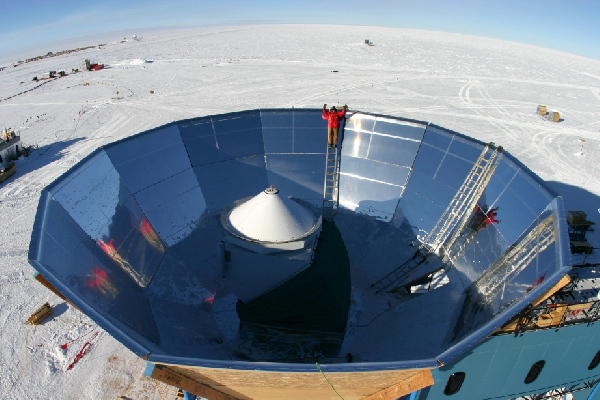
QUaD telescope inside the reflective ground shield: The ground shield prevents black-body radiation from the ground from reaching the telescope. QUaD used an on-axis Cassegrain design with an under-illuminated 2.6m primary mirror (at the center of the Shield) for an angular resolution of 4.6 arcmin at 150 GHz. The mount is located at the South Pole and was formerly occupied by the University of Chicago DASI experiment.
more...
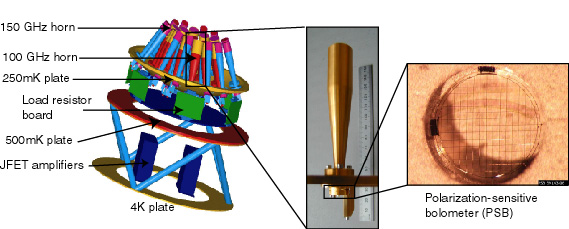
There were 31 corrugated feed horns, each feeding a polarization-sensitive bolometer (PSB) pair manufactured at the Jet Propulsion Laboratory.
more...
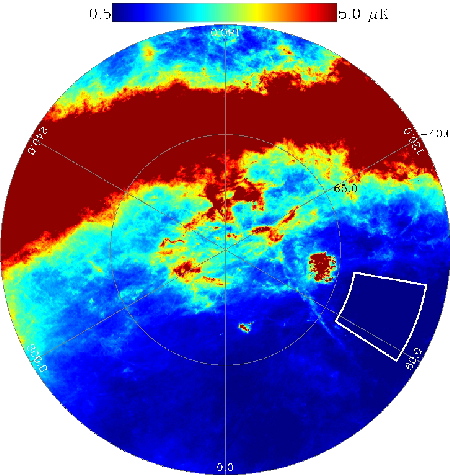
Sky foregrounds at 150 GHz from the South Pole, where red is the brightest and blue the faintest foreground signal. QUaD looked at a portion of clean sky located in the region outlined in white. The maps were used to construct power spectra for the E and B modes.
more...
Images Courtesy of the Stanford University Church GroupOverviewQUaD was a bolometric array receiver used to search for polarization in the CMB. The spatial distribution of polarization contains important information about cosmological parameters and about the origin of temperature anisotropies in the CMB. Although the signal is tiny (1-10% of the temperature fluctuations) the scientific rewards are large. QUaD observed a ∼100 square degree area of sky, centered on RA 5.5h, Dec −50°. The heart of QUaD was a 31-element focal plane shown schematically below. There were 31 corrugated feed horns, each feeding a polarization-sensitive bolometer (PSB) pair manufactured at the Jet Propulsion Laboratory. Each device comprised a linear mesh of metalized silicon-nitride that absorbs only one direction of linear polarization. The temperature change in the bolometer was then detected by an NTD (neutron transmutation-doped) germanium thermistor (the dark rectangle at the edge of the web). A PSB pair measures the intensity of the radiation in orthogonal linear polarizations as the telescope scanned across the sky. These signals were then processed into a map of the polarization pattern on the sky. QUaD's name means: QUEST (Q and U Extragalactic Sub-mm Telescope) at DASI (Degree Angular Scale Interferometer) Experiment Information:
The QUaD website can be viewed HERE. |