VSA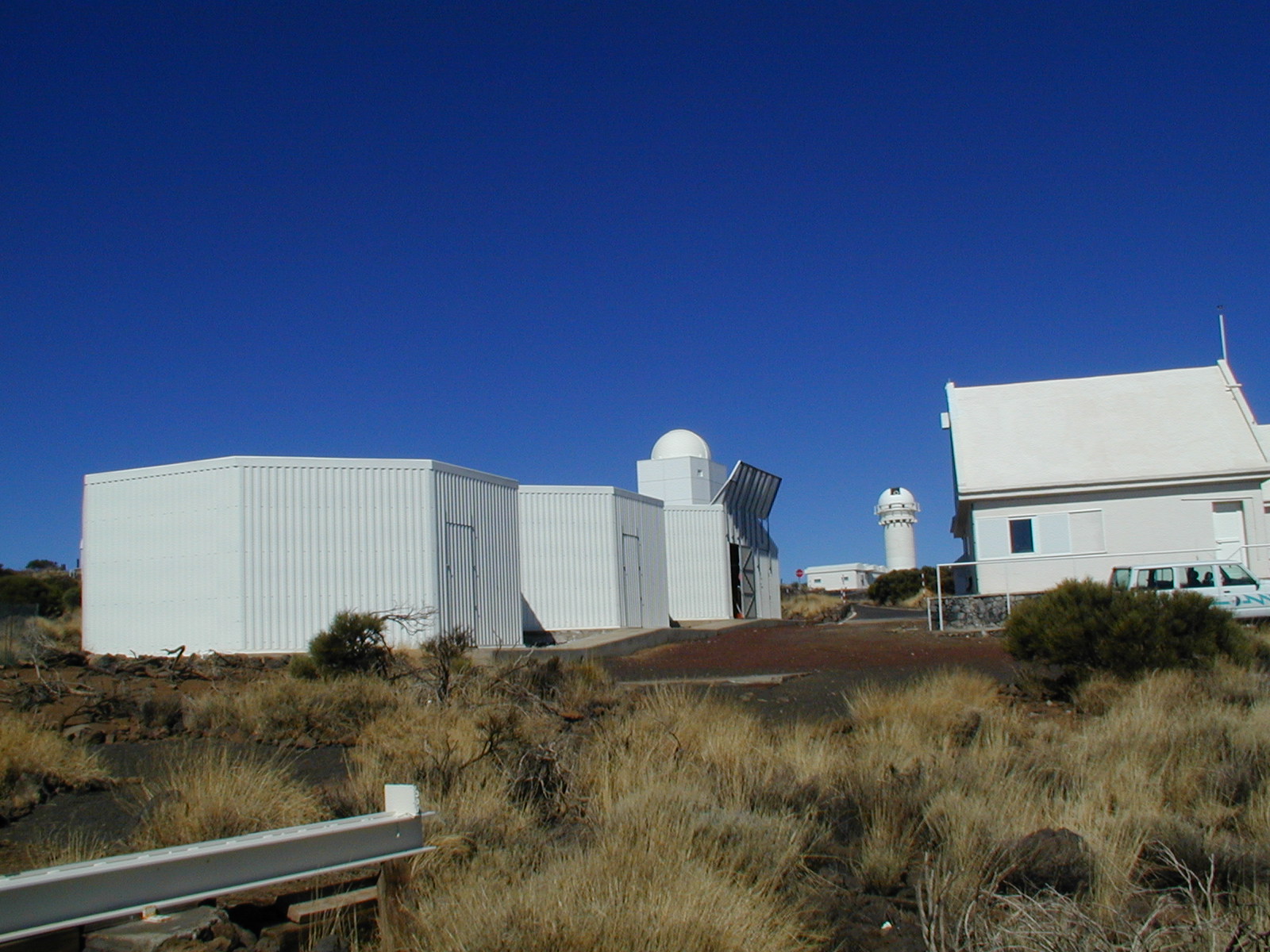
The site of the VSA Experiment enclosure and control building seen from the south east.
more...
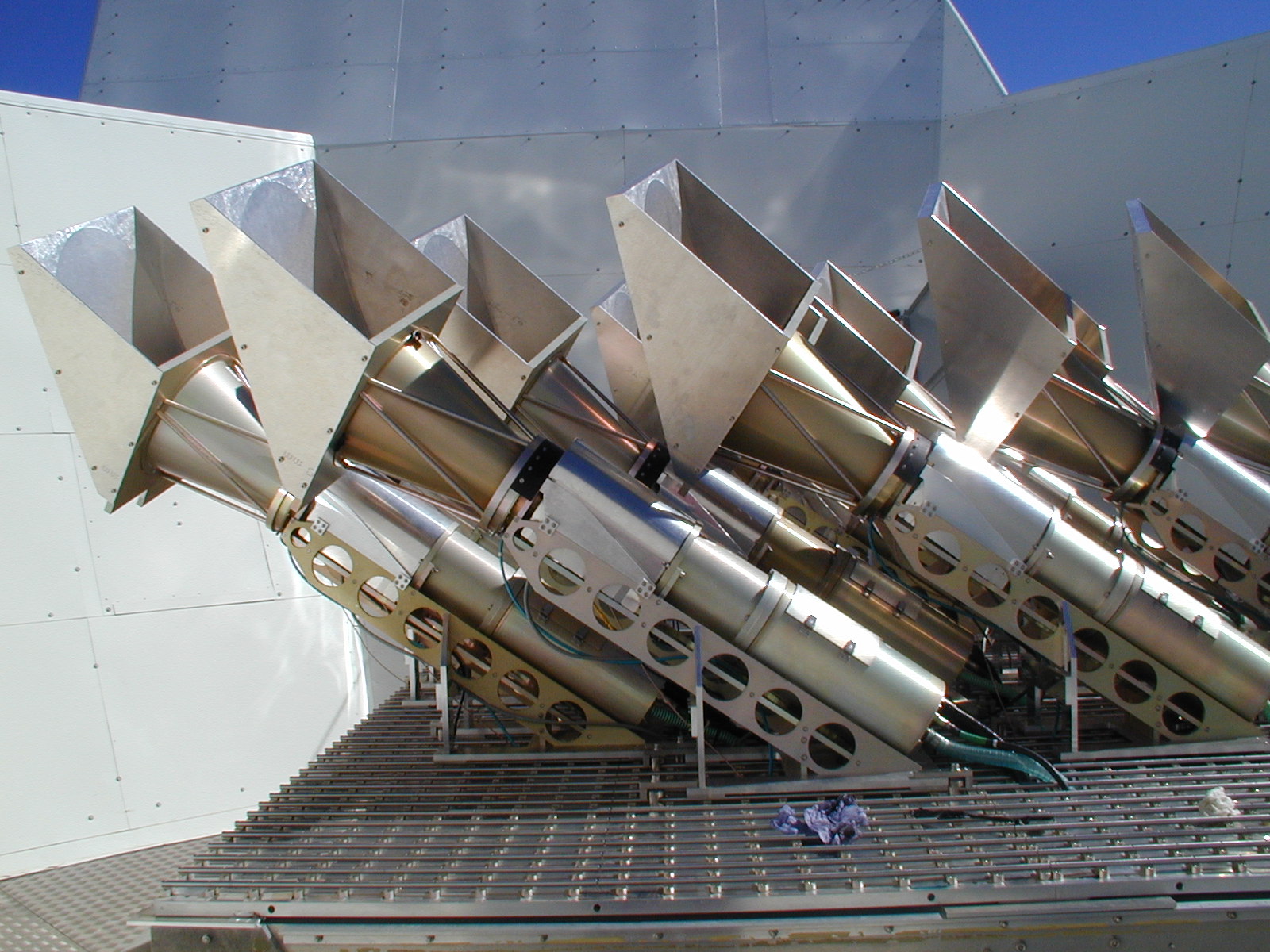
2002 configuration of the 14 feed horn array, viewed from the west side of the table.
more...
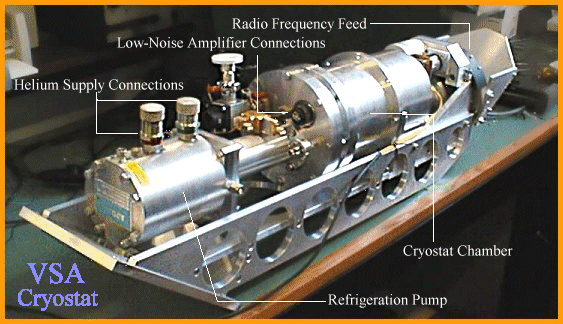
Receiver mounted in its support cradle.
more...
Images Courtesy of the Jodrell Bank Centre for AstrophysicsOverviewVSA (Very Small Array) was an interferometeric radio telescope operating in the Ka-band (26 - 36 GHz), purpose-built for the study of the CMB. The receivers, with their horn antennas, formed an aperture synthesis array to give the resolution of a much larger system - defined by the size of the array - but capable of simultaneously observing a much larger area of the sky than a single large antenna. VSA was installed at the Observatory on Mount Teide, Tenerife at a height of 2.5 km; the site was chosen for its low atmospheric water vapor compared to lower altitude sites in the UK.The first set of CMB observations occurred during 2000-2001, with the VSA in the "compact array configuration". This configuation allowed determination of the CMB temperature power spectrum for multipoles 150 - 900, with sky regions and 34 GHz frequency channel both chosen to minimize foreground contamination. VSA was placed in the higher sensitivity "extended array" configuration for observations from 2001 - 2003. This configuration produced a synthesized FWHM beamwidth of ∼ 11 arcmin and covered an ℓ-range of 300 to 1500. The final delivered TT power spectrum was derived using a sky area of 82 sq deg. A total ℓ-range of 150 − 1500 was achieved by combining the complete extended array data with the earlier compact configuration data. VSA was reconfigured to a 'super-extended' array in 2005, with a synthesized beam of 7 arcmin, and used for other studies. Experiment Information:
The VSA website can be viewed HERE. |