White Mountain

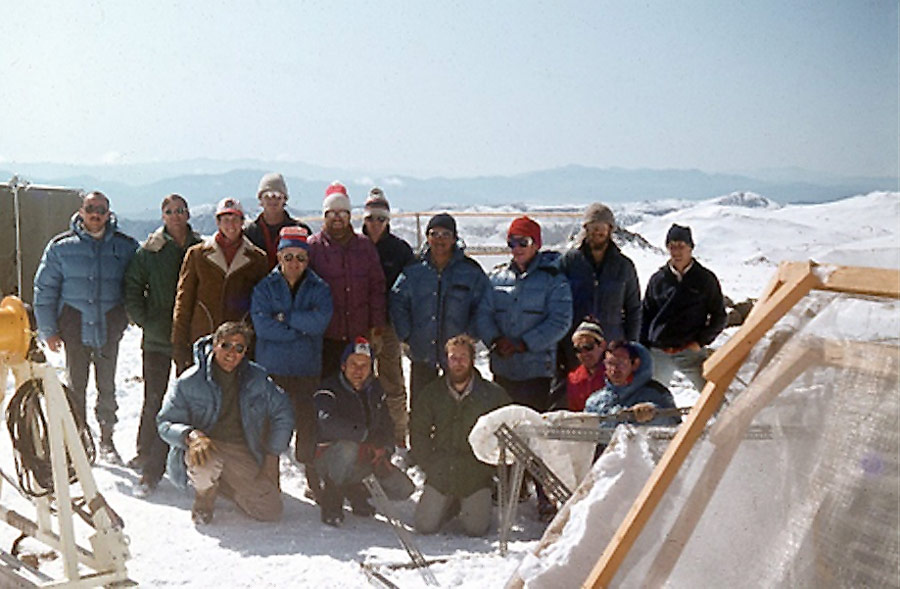
Collaboration Team portrait on a snowy mountain top, surrounded by equipment.

Images Courtesy of the University of California White Mountain Collaboration Team

Barcroft Observatory of the University of California White Mountain Research Station - Collaboration Team portrait on a snowy mountain top, surrounded by equipment.


Overview

The White Mountain Collaboration made measurements of the CMB temperature at five frequencies from 2.5 to 90 GHz. The goal of this experiment was to measure the low-frequency spectrum of the cosmic background radiation at several frequencies with small systematic errors to look for distortions from a blackbody distribution. Initial observations were made in July 1982. Modifications to the radiometers were then made to improve data quality and subsequent observations made in Aug/Sept 1983.

White Mountain Observations

  • Measurements of the absolute difference ΔT between the antenna temperatures of the sky at the zenith (antenna upward) and a black body at Liquid Helium temperature (antenna downward) at five frequencies: 2.5 , 4.75, 10, 33 and 90 GHz.
  • Heterodyne radiometers can be moved along a rail and set above a black body source (optically thick Eccosorb target covered by Liquid Helium at ambient pressure in a 70 cm diameter dewar)
  • Geometrically scaled, corrugated horns tiltable between zenith (sky) and nadir (cold load) directions. When looking down the horn circular mouth can be attached to the dewar mouth
  • Atmospheric and galactic foregrounds measured by zenith and drift scans
  • A separate 9.4 GHz radiometer entirely dedicated to simultaneous studies of the atmospheric emission
  • Observations from University of California White Mt. Research Station (3800 m altitude)
  • Participating institutions

    2.5 GHz : Physics Dept. – University of Milano – Italy
    4.75 GHz : Istituto TESRE – CNR – Bologna – Italy
    9.4 GHz : Haverford College - Haverford (Pa) – USA
    10 GHz : LBL – Berkeley (Ca) – USA
    33 GHz : LBL – Berkeley (Ca) – USA
    90 GHz : LBL – Berkeley (Ca) – USA
    ---- : Physics Dept. – University of Padova - Italy

(see Smoot, G.F. et al. 1983, Phys.Rev.Lett. 51, 1099 ADS, and Smoot, G.F. et al. 1985, Ap.J., 291, L23 ADS)


Experiment Information:

  • Experiment Date Range in Years: 1982 - 1983
  • Frequency (GHz): 2.5, 4.75, 9.4, 10, 33, 90
  • l-min: n/a
  • l-max: n/a

A service of the HEASARC and of the Astrophysics Science Division at NASA/GSFC

HEASARC Director: Dr. Andrew F. Ptak

LAMBDA Director: Dr. Thomas M. Essinger-Hileman

NASA Official: Dr. Thomas M. Essinger-Hileman

Web Curator: Mr. Michael R. Greason